
Table of Contents
There Is a Cost Your Business Is Already Paying
It does not appear on any invoice. It is not captured in your agency retainer or your monthly SEO report. It does not trigger an alert or surface in your analytics dashboard. But it is real, it is measurable, and for most Singapore businesses investing seriously in digital marketing, it represents one of the largest and most consistent drains on marketing return in their entire operation.
We call it the Inefficiency Tax.
As we established in our master briefing on Search Engine Optimization in 2026, modern SEO is no longer about simple keywords—it is an engineering discipline where infrastructure dictates your visibility.
The Inefficiency Tax is what your business pays when poor website infrastructure reduces the return on every other digital investment you make. Slow server response times make every page load harder to justify to a visitor who arrived expecting speed. Crawl inefficiency means search engines spend their limited crawl allocation on low-value URLs instead of the pages that drive your revenue. JavaScript rendering gaps create an invisible website problem where content your users see clearly is completely absent from what Googlebot evaluates. Core Web Vitals failures suppress your organic search rankings and raise your Google Ads cost per click at the same time.
None of these problems announce themselves with an obvious symptom. Your website appears to function. Traffic arrives. Some conversions happen. The business continues. But the gap between the results you are currently generating and the results your marketing investments are capable of producing quietly widens every month the underlying technical problems remain unaddressed.
This post examines the specific infrastructure failures that cost Singapore businesses the most in lost organic visibility and wasted advertising spend, explains how each failure translates into a measurable business cost, and describes what genuine remediation involves.
Why Infrastructure Is the Foundation of Every Digital Investment
Search Engine Processing Pipeline
Search engines evaluate every webpage through a structured process to determine whether the page should appear in search results and how it should rank.
Crawl Stage
Googlebot retrieves page content including HTML, links, and metadata from website servers.
Render Stage
Google processes HTML, CSS, and JavaScript to generate the fully rendered version of the webpage.
Index Stage
Rendered content is stored in Google's search index, making it eligible to appear in results.
Ranking Stage
Google evaluates relevance, page experience, and authority to set final rankings.
Website Infrastructure
Server performance, site architecture, and technical SEO determine how efficiently search engines crawl, render, and index webpages. Well-optimised infrastructure helps search engines process pages faster and improves overall search visibility.
Most businesses think about digital marketing in this order: strategy first, content second, distribution third, technical foundation last or never. This sequencing is wrong and it is expensive.
Technical infrastructure is not the last layer of digital marketing. It is the first. Every content investment, every advertising campaign, and every SEO effort either inherits the strength of a well-built technical foundation or absorbs the weakness of a broken one.
Google processes every website through a four-stage chain: crawl, render, index, rank. Googlebot visits a URL, records the server response, processes the content, adds it to the index, and evaluates it for ranking against relevant queries. Website infrastructure affects every stage of this chain. A failure at any stage reduces the effectiveness of every stage downstream from it.
A joint study by Deloitte and Google found that a 0.1 second improvement in mobile site speed increased conversion rates by 8 percent for retail sites and increased average order value by 10 percent. For a Singapore business generating SGD 100,000 per month in online revenue, that single infrastructure improvement represents SGD 10,000 in additional monthly revenue. Not because the product changed. Not because pricing improved. Because the server stopped being the bottleneck. That is the Inefficiency Tax made concrete before examining a single other failure.
Server Response Time and Time to First Byte
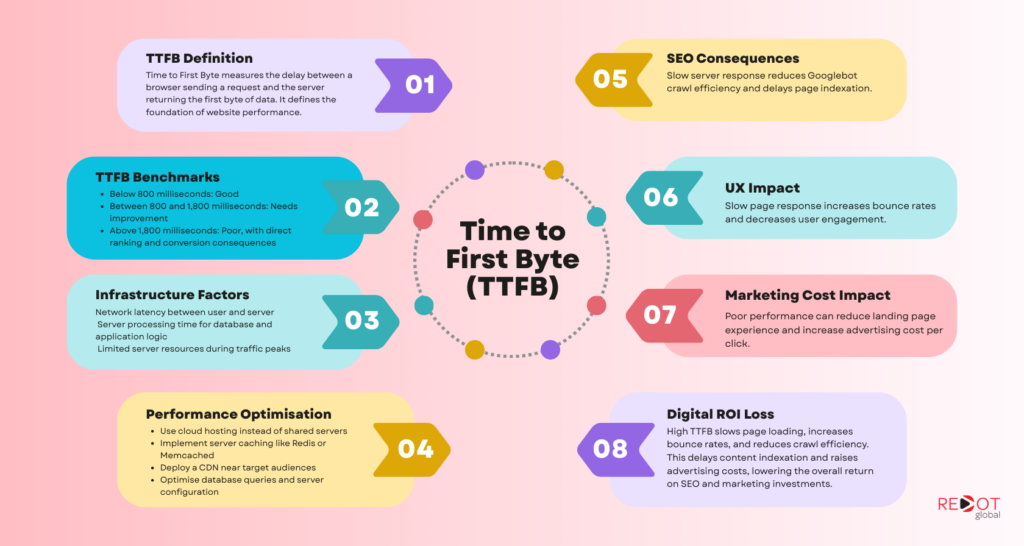
Time to First Byte is the elapsed time between a browser sending an HTTP request to a server and receiving the first byte of the response. It is the foundational metric of server performance because every subsequent page load event, resource requests, HTML parsing, CSS rendering, JavaScript execution, and image loading, happens downstream of it. A slow TTFB sets a performance ceiling that no frontend optimisation can fully overcome.
Google’s technical documentation on TTFB recommends the following thresholds:
- Below 800 milliseconds: Good
- Between 800 and 1,800 milliseconds: Needs improvement
- Above 1,800 milliseconds: Poor, with direct ranking and conversion consequences
In our infrastructure audits across Singapore and Southeast Asia, shared hosting environments routinely return TTFB above 1,800 milliseconds under concurrent load, placing them firmly in Google’s Poor classification before any frontend optimisation is considered.
TTFB is determined by three interacting factors:
- Physical network latency between the user or crawler and the server contributes a fixed delay based on geographic distance. This is why Content Delivery Networks serving content from edge nodes close to visitors reduce effective TTFB for geographically distant users.
- Server processing time, which includes database queries, application logic execution, and response assembly, contributes a variable delay reflecting the efficiency of the server configuration and application code.
- Server resource availability under concurrent load determines whether requests are processed promptly or queue behind competing processes during traffic peaks.
Remediation requires infrastructure-level interventions. Migrating from shared hosting to managed cloud infrastructure with dedicated resources eliminates resource contention. Implementing server-side caching through tools like Redis or Memcached serves pre-computed responses for frequently requested pages rather than regenerating them on each request. Deploying a CDN with edge nodes positioned close to Singapore and Southeast Asian visitors reduces geographic latency. Optimising database query performance through indexing and connection pooling reduces server processing time for dynamic pages.
The Inefficiency Tax from high TTFB extends beyond user-facing load time. According to Google’s crawl budget documentation, Googlebot allocates a finite crawl capacity per domain per session. Slow server responses consume that allocation faster, meaning fewer pages are processed per crawl visit. New content takes longer to be indexed and ranking improvements take longer to materialise, taxing the return on every piece of content published on a slow server.
JavaScript Rendering and the Invisible Website Problem
While frameworks like React, Next.js, and Vue offer high interactivity, they often rely on client-side rendering. This creates a fundamental crawling challenge for search engines. Even PHP-based frameworks like Laravel can face these issues if they are used primarily to serve heavy JavaScript bundles.
To understand why this matters, it helps to contrast the two rendering approaches. In traditional server-side rendering, the server prepares the complete HTML page before sending it to the user. Googlebot receives the full content, all internal links, and all structural metadata immediately on the first crawl. In client-side rendering, the server delivers a minimal HTML shell and the user’s browser has to build the page using JavaScript. The full content and link structure exists only after JavaScript has executed in the browser.
According to Google’s JavaScript SEO documentation, Googlebot queues all pages for rendering after the initial crawl. Once Google’s resources allow, a headless Chromium instance renders the page and executes the JavaScript. The page may stay in this render queue for a few seconds, but it can take considerably longer for larger sites, JavaScript-heavy pages, or domains with lower crawl priority. During this interval the page’s content and internal links are not fully represented in Google’s index.
For websites where navigation menus, internal link structures, primary content, or metadata are JavaScript-dependent, Googlebot may be navigating and evaluating a fundamentally different version of the site than users experience. Pages that appear richly linked and content-complete in a browser may appear sparse and poorly connected in the raw HTML that Googlebot captures on first pass.
Diagnosing JavaScript rendering gaps requires comparing the raw HTML source (the initial code sent by the server before any JavaScript runs) against the fully rendered DOM output (the final page the user actually sees after JavaScript runs). Google Search Console’s URL Inspection tool provides this comparison directly, showing both the crawled HTML Googlebot captured and the rendered version it produced after JavaScript processing.
Remediation options include:
- Server-side rendering, where JavaScript executes on the server before the response is sent so the delivered HTML already contains fully rendered content
- Static site generation, which pre-builds complete HTML files for all pages at build time and is appropriate for content pages where dynamic personalisation is not required
- Ensuring critical content exists in raw HTML before JavaScript execution for cases where full SSR is not architecturally viable
Every month a Singapore business operates with undiagnosed JavaScript rendering gaps is a month it pays the Inefficiency Tax on every piece of content that depends on client-side rendering to be visible to search engines.
Crawl Budget Waste and Indexation Delay
Crawl budget is the finite crawl capacity Googlebot allocates to a domain based on its authority signals, server performance under crawl load, and the crawl demand created by links and sitemaps. When this budget is consumed by URLs that provide no indexation value, the pages that directly support business outcomes get crawled less frequently, indexed more slowly, and updated in Google’s index with greater delay.
Google’s crawl budget documentation identifies crawl budget as a product of crawl capacity limit and crawl demand. For small websites crawl budget is rarely a constraint. For larger websites with hundreds or thousands of URLs it becomes a strategic resource that must be managed deliberately.
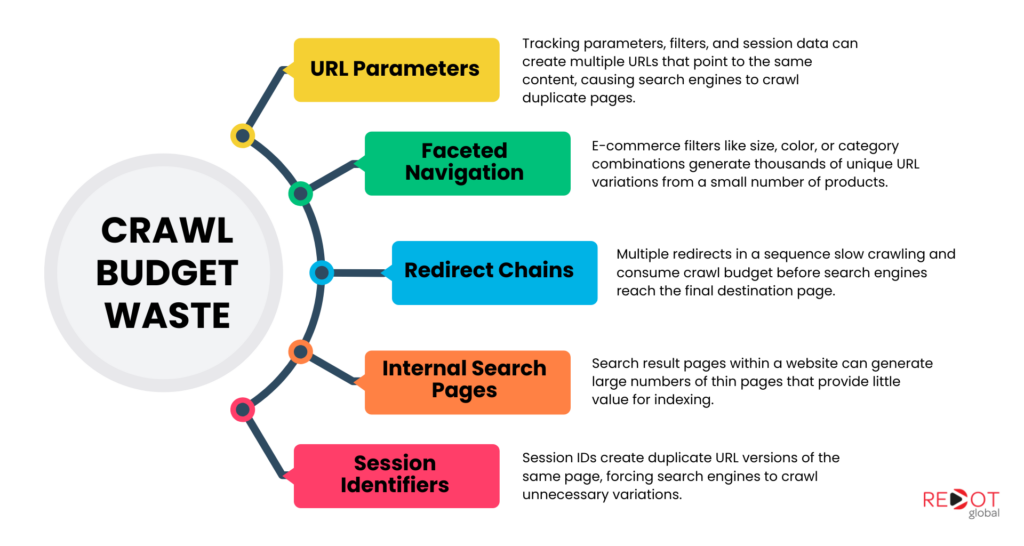
The most common sources of crawl budget waste include:
- URL parameter proliferation from tracking scripts, session identifiers, and filter combinations generating multiple unique URLs for the same underlying content
- Faceted navigation on e-commerce and directory websites generating tens of thousands of unique URL combinations from a limited product catalogue
- Redirect chains adding unnecessary intermediate steps to every crawl path, consuming budget before Googlebot reaches destination pages
- Internal search result pages accessible to crawlers, returning unique URLs for each query string with thin content that contributes nothing to indexation value
- Session identifiers creating duplicate URL variants that Googlebot treats as separate pages requiring individual crawl requests
Identifying crawl waste accurately requires server log file analysis rather than crawl simulation tools. Crawl tools simulate what a crawler could access by following links. Server log files record what Googlebot actually requested, at what frequency, with what server response times, and with what HTTP status codes.
Google Search Console’s Crawl Stats report provides a useful starting point, showing total crawl requests, response code distribution, and file type breakdown over the previous 90 days. For URL-level detail that Crawl Stats does not expose, server log file analysis is essential.
Remediation involves blocking low-value URL patterns through robots.txt, implementing consistent canonical tags on parameter variants, configuring URL parameter handling through Google Search Console, applying noindex tags to internal search result pages, and restructuring internal linking to create clear crawl paths toward high-value destination pages.
Crawl budget waste is a silent Inefficiency Tax that grows proportionally with the size of the website. Every unnecessary URL crawled is a revenue-generating page that did not get crawled instead.
Internal Linking Architecture and PageRank Distribution
Internal linking is the structural mechanism through which link equity and crawl priority flow between pages within a website. The architecture of internal links determines how PageRank distributes across the domain, how efficiently Googlebot discovers all pages during crawl sessions, and how effectively users navigate from informational content toward commercial conversion pages.
PageRank flows through link relationships. External backlinks from authoritative domains contribute link equity to the pages they point to. Internal links then redistribute that equity throughout the site according to the internal link architecture. A page with significant external link equity but no internal links pointing to it retains that equity locally without sharing it with the pages that need it most.
Moz’s guide to internal linking explains that internal link equity is a material ranking factor at the individual page level. The internal link architecture of a website is a ranking distribution mechanism that determines which pages benefit most from the domain’s accumulated authority.
The internal linking failures that most consistently undermine search performance for Singapore businesses include:
- Blog posts not linking to service pages, creating a content ecosystem where topical authority accumulates without being directed toward commercial conversion
- Orphaned pages with no internal links pointing to them, receiving no PageRank transfer regardless of content quality
- Generic anchor text such as “click here” or “learn more” providing no topical signal to Googlebot about the destination page’s subject matter
- Important commercial pages sitting five or six clicks from the homepage, receiving PageRank diluted at each intermediate step
For websites operating a pillar and cluster content model, internal linking is the connective architecture that activates the model’s full authority potential. Each cluster post must link back to its pillar page with descriptive anchor text. The pillar page must link to related service pages. Without this bidirectional structure operating consistently, the topical cluster model delivers only a fraction of its potential ranking impact.
Poor internal linking architecture is an Inefficiency Tax on every external backlink the domain has earned, diverting accumulated authority away from the pages that need it most.
Core Web Vitals as Ranking Signals and Advertising Cost Drivers
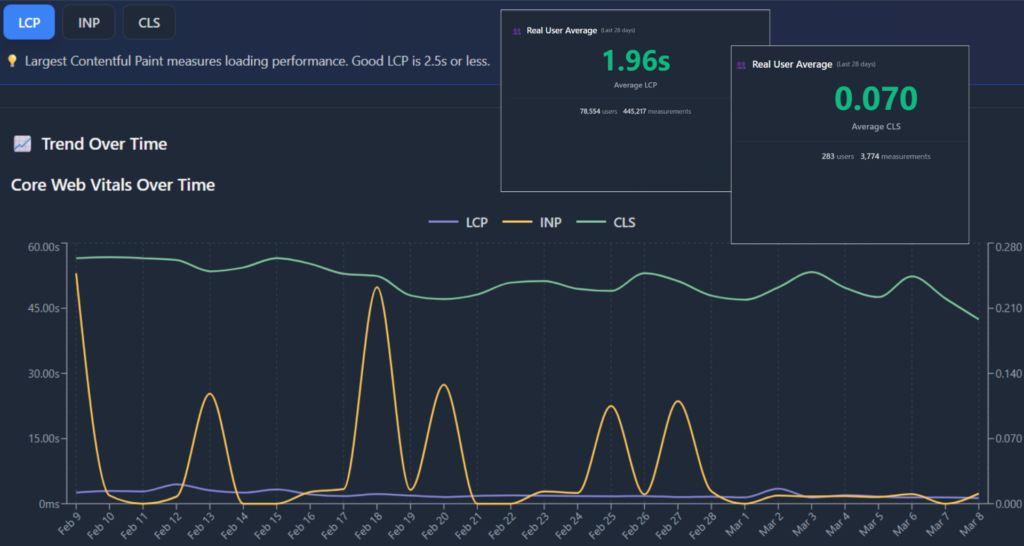
Core Web Vitals are confirmed Google ranking signals that measure real user page experience across three dimensions:
- Largest Contentful Paint (LCP): How quickly the primary visible content of a page loads
- Interaction to Next Paint (INP): How quickly the page responds to user input after loading
- Cumulative Layout Shift (CLS): How visually stable the page is during loading
All three are measured using field data collected from real Chrome users through the Chrome User Experience Report, not laboratory simulations.
The distinction between field data and laboratory data is critically important. A page can achieve passing scores in PageSpeed Insights lab tests and simultaneously fail in the field data Google uses for ranking. The lab test runs on a standardised device and connection specification. Field data captures every mid-range Android device on every 4G connection that real visitors use.
Singapore’s actual user base includes a significant proportion of visits from mid-range Android devices on mobile connections. JavaScript-heavy pages that render quickly on developer hardware may generate poor Interaction to Next Paint scores on lower-specification devices because the same JavaScript execution takes significantly longer on less powerful processors.
Google Search Console’s Core Web Vitals report shows field data performance disaggregated by URL group, device type, and individual metric, making it the most important starting point for identifying which page types and device categories are failing thresholds.
The most common failure causes are:
- Render-blocking resources: Synchronously loaded CSS and JavaScript files that must fully download and execute before the browser can display primary content, causing LCP delays
- Unoptimised images: Large hero images served at full resolution to all devices regardless of screen size
- Third-party scripts: Analytics platforms, advertising pixels, live chat widgets, and tag management systems that congest the main thread and delay INP
- Elements without defined dimensions: Images and embedded content that cause visible layout shifts as they load, contributing to poor CLS scores
The business impact extends directly into paid advertising. Landing page experience is a direct Quality Score input. WordStream’s Quality Score research quantifies this precisely:
- At Quality Score 4: Advertisers pay approximately 25 percent above the baseline auction CPC
- At Quality Score 8: Advertisers pay approximately 37 percent below baseline
The difference between a poorly performing and well-performing landing page can mean paying SGD 3.50 per click instead of SGD 1.80 per click on the same keyword across every campaign running to affected pages.
The Inefficiency Tax from Core Web Vitals failures is unique because it charges twice: once in suppressed organic rankings and again in inflated advertising costs for every click paid to reach the same pages.
Site Architecture and Crawl Efficiency
Site architecture encompasses the hierarchical organisation of pages, the logical grouping of related content, the URL structure representing that hierarchy, and the navigation systems that make it accessible to users and search engines. How a site is structured determines how efficiently Googlebot navigates from entry points to destination pages and how effectively PageRank concentrates on the pages that need it most.
Page depth directly affects both crawl frequency and PageRank transfer. At each link hop in a crawl path, PageRank is diluted across all outgoing links from the linking page. A page reachable in two clicks from the homepage receives substantially more PageRank transfer than a page reachable only after five or six clicks. Googlebot also crawls pages reached by fewer hops more frequently because they are encountered earlier in every crawl session before the budget allocation runs out.
URL structure communicates topical relationships and hierarchy to crawlers and users alike. A URL path like /blog/technical-seo/crawl-budget-guide/ communicates category membership and topical context at the URL level. A flat URL structure where all pages sit at the root domain level provides no hierarchical signal, making it harder for Google to understand topical relationships between pages.
For Singapore businesses whose websites have grown organically over several years, the resulting architecture typically reflects historical development rather than deliberate planning. The most common problems include:
- Important service pages sitting at inconsistent depths relative to their commercial value
- Blog content organised by publication date rather than by topic
- Related content spread across sections that do not reflect genuine topical relationships
The table below compares the measurable difference between legacy infrastructure and a properly optimised architecture across the metrics that most directly affect search performance and advertising efficiency.
Table: Legacy Infrastructure vs Optimised Infrastructure — Key Performance Metrics for Singapore Businesses
| Metric | Legacy Infrastructure | Optimised Infrastructure |
| TTFB | Commonly above 1,800ms on shared hosting | Below 800ms (Google Good threshold) |
| Crawl efficiency | High waste on low-value URLs | Budget concentrated on revenue pages |
| JavaScript indexation | Delayed second wave, content gaps | Fully rendered HTML on first crawl |
| Core Web Vitals | Failing in field data | Passing across device distribution |
| Google Ads Quality Score | 3 to 5, paying CPC premium | 7 to 9, paying below baseline CPC |
| New content indexation | Days to weeks | Hours to days |
| PageRank distribution | Diluted across deep hierarchy | Concentrated on high-value pages |
Architectural remediation requires URL restructuring with 301 redirects to preserve accumulated link equity, navigation redesign to create logical hierarchical pathways within a minimal number of clicks, and systematic internal link rebuilding to establish the pillar and cluster connections the new architecture requires.
An unresolved architecture problem is an Inefficiency Tax on every content and authority signal the site has accumulated, distributing those signals across a structure that prevents them from concentrating where they would deliver the most ranking impact.
Why Content Cannot Compensate for Infrastructure Failure
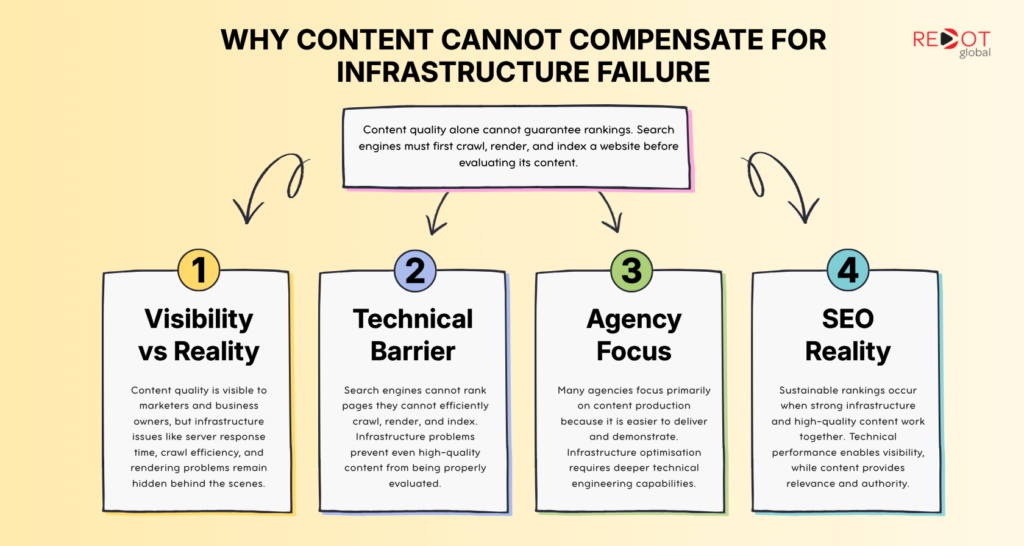
The conclusion most agencies avoid is this: content quality cannot compensate for infrastructure failure. A technically sound competitor with average content will consistently outperform a technically broken website with excellent content because Google cannot rank pages it cannot efficiently crawl, render, index, and evaluate.
The misconception persists because content is visible and infrastructure is not. Business owners and marketing managers can read a blog post and assess its quality. They cannot see a server response time, a JavaScript rendering gap, or a crawl budget distribution report. Agencies without infrastructure engineering capability prefer to focus client attention on content because it is within their capability to deliver.
Addressing your website infrastructure is the most direct path to recovering the SEO ROI that poor technical performance has been silently consuming. Infrastructure and content quality reinforce each other when both are operating correctly. A technically excellent site with weak content will not sustain rankings. A content-rich site on broken infrastructure will not reach the rankings its content deserves. The Inefficiency Tax stops compounding only when both layers are working together.
How to produce content that meets the information gain standard Google rewards is covered in our information gain content strategy guide.

How Redot Global Approaches Infrastructure Remediation
Effective infrastructure remediation requires SEO engineers and developers working on the same problems, in the same environment, accountable to the same business outcomes. The conventional model where an SEO team produces an audit report and hands a recommendation list to a separate development team consistently produces partial fixes because the people implementing changes lack the SEO context to prioritise correctly.
Redot Global’s technical SEO practice integrates SEO engineers and developers on the same client engagements. We diagnose infrastructure problems at the server level, the application code level, and the CDN level. As a certified AWS Network Partner, our infrastructure capability extends from server performance optimisation and crawl budget management through to Edge SEO implementation via AWS CloudFront and Lambda@Edge.
Edge SEO allows canonical tags, redirect rules, HTTP header modifications, and content adjustments to be deployed at the CDN layer without requiring origin server deployment cycles. For enterprise websites where development release schedules create weeks of delay between identifying a technical problem and deploying its fix, Edge SEO eliminates that delay entirely.
A technical infrastructure audit conducted by Redot Global covers:
- Server response performance and TTFB measurement across page types and device conditions
- JavaScript rendering gap analysis comparing raw HTML source against rendered DOM output
- Crawl budget assessment through server log file analysis identifying specific URL patterns consuming crawl allocation
- Core Web Vitals field data review disaggregated by page type and device category using Google Search Console data
- Internal link architecture mapping with PageRank flow analysis
- Site structure evaluation against the topical cluster model the content strategy requires
The output is a remediation plan prioritised by business impact. The fixes that stop the most significant revenue leakage come first. Implementation is managed by the same team that conducted the diagnostic work, with accountability for outcomes rather than just the delivery of a report.
Infrastructure is the foundation, but it is only the first stage of building a high-value digital asset. To understand how we integrate technical excellence with Information Gain and E-E-A-T, explore our full What is Search Engine Optimization in 2026 guide.
Stop paying the Inefficiency Tax today. Contact Redot Global for a comprehensive technical infrastructure audit and reclaim your digital ROI.
Frequently Asked Questions
What is the Inefficiency Tax in digital marketing?
The Inefficiency Tax is the cumulative reduction in marketing ROI caused by poor website infrastructure. When server response is slow, crawl budget is wasted, JavaScript prevents complete indexation, or Core Web Vitals fail under real user conditions, every investment in SEO, content, and paid advertising produces lower returns than the same investment would produce on a technically sound website. It is called an inefficiency because it is not a deliberate cost. It is a consequence of technical failures that most businesses are not aware they are paying.
How does Time to First Byte affect search engine rankings?
TTFB is the foundational measurement of server performance and a direct contributor to total page load time. Slow TTFB increases load time, raises bounce rate, and reduces session quality. These user engagement signals feed into Google’s quality assessment of pages. Additionally, high TTFB reduces Googlebot’s crawl efficiency because each crawl request takes longer to complete, reducing how many pages can be crawled within the domain’s allocated crawl budget per session.
What is crawl budget and how does it affect indexation?
Crawl budget is the number of pages Googlebot will crawl on a domain within a given period, determined by the server’s crawl rate tolerance and Google’s assessment of how many URLs on the domain merit crawling. When crawl budget is consumed by low-value URLs including parameter variants, redirect chains, and faceted navigation combinations, important service and product pages receive fewer crawl visits. This delays indexation of new content and slows the propagation of ranking improvements.
Why does JavaScript framework usage create SEO risks?
JavaScript frameworks including React, Next.js, and Vue deliver content through client-side rendering, where the browser builds the page using JavaScript rather than receiving fully rendered HTML from the server. Google’s Web Rendering Service processes JavaScript in a delayed second wave after the initial crawl. Content and internal links that exist only after JavaScript execution may not be captured in the initial crawl or may be indexed with significant delay. Server-side rendering eliminates this risk by ensuring fully rendered HTML is delivered in the initial server response.
What is the connection between Core Web Vitals and Google Ads performance?
Core Web Vitals scores feed into Google Ads landing page experience ratings, which contribute to Quality Score calculations. Quality Score directly determines the cost per click multiplier applied in Google Ads keyword auctions. Pages with poor Core Web Vitals receive lower landing page experience scores, which reduce Quality Score and increase effective cost per click. Improving Core Web Vitals on landing pages reduces advertising cost per click and improves ad position at the same bid level.
How does site architecture affect organic search rankings?
Site architecture determines how PageRank flows between pages, how efficiently Googlebot discovers all pages during crawl sessions, and how coherently authority concentrates on pages that need to rank competitively. Pages that sit deep in the link hierarchy receive PageRank diluted at each intermediate step and receive less frequent crawl visits. Commercial pages that need to rank competitively must sit close to the domain root and receive strong internal linking from contextually related pages throughout the site.
What does Edge SEO mean and when is it the right solution?
Edge SEO refers to deploying technical SEO fixes at the CDN layer rather than at the origin server. CDN edge nodes in networks such as AWS CloudFront can modify HTTP headers, apply redirect rules, inject HTML content, and handle canonical tags before requests reach the origin server. This allows technical SEO changes to be deployed globally within minutes without requiring development releases. Edge SEO is particularly valuable for enterprise websites with slow development release cycles, for large-scale redirect management, and for header-based technical fixes including HSTS configuration, X-Robots-Tag implementation, and cache control modifications.

Technical SEO Engineer and Full-Stack Developer, Redot Global
Pawan Rodrigo is a Technical SEO Engineer and Full-Stack Developer at Redot Global, where he builds the technical infrastructure that connects SEO, performance marketing, and data into automated, production-ready systems. His work spans full-stack platform development, web crawler engineering, Core Web Vitals optimisation, JavaScript rendering analysis, and AI-driven automation across SEO workflows and marketing operations. He specialises in building systems where technical SEO and paid media performance talk to each other, implementing end-to-end conversion tracking including server-side offline conversion integration with Google Ads. He holds multiple current Google Ads certifications and brings over 14 years of experience across technical and data-driven roles.