


Key takeaways
- 44.2% of all LLM citations come from the first 30% of content. Where your insight appears determines whether it gets cited.
- Google’s February 2026 core update explicitly increased the weighting of information gain as a ranking signal. Aggregated and AI-generated content without original analysis lost visibility across every industry.
- Information gain affects both traditional Google rankings and AI citation selection through different but reinforcing mechanisms. Improving one improves the other.
- Heavily cited content has an entity density of 20.6% compared to 5-8% in standard text. Named, verifiable references are what AI systems cite. Generic references are not citable.
- 78.4% of citations that contain questions come from headings. Your H2 tag is the user query. The paragraph immediately beneath it is the answer.
- Semantic completeness is a citation multiplier. Pages that address a topic’s adjacent concepts in the same document earn higher AI retrieval confidence than pages that address one dimension in isolation.
What is information gain in SEO?
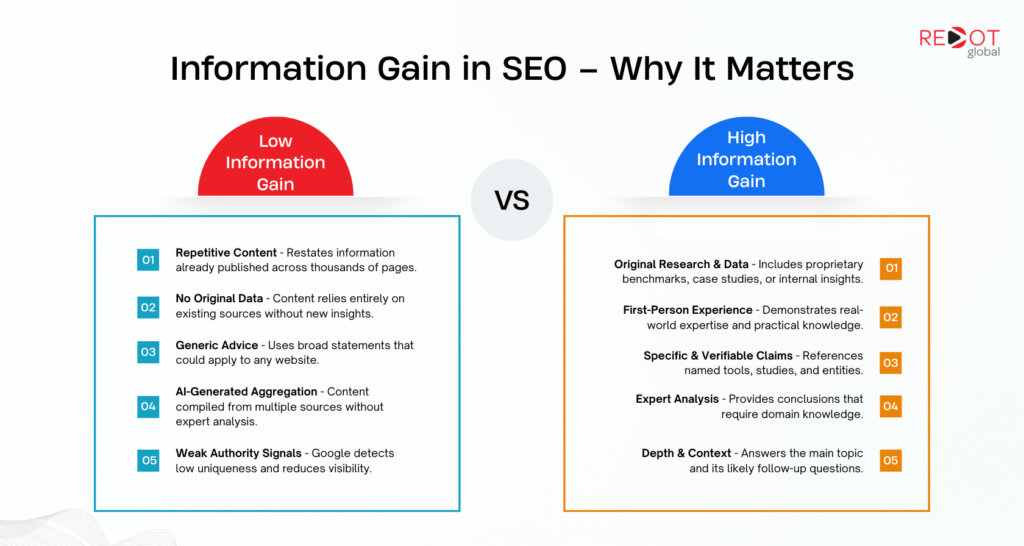
Information gain is the measure of genuinely new, unique, and verifiable insight your content adds to the web. It is not a measure of length, keyword density, or how comprehensively a topic is covered in general terms. It is a measure of whether your content tells Google and AI systems something they cannot already find expressed in identical or near-identical form across thousands of other pages.
Google’s systems have evaluated information gain as a quality signal since the Helpful Content Update era. Google’s February 2026 core update explicitly increased the weighting of information gain as a ranking signal, with sites publishing original, expert-driven content gaining visibility while those producing aggregated or AI-generated content without meaningful human oversight saw measurable ranking losses.
The mechanism is straightforward. Google indexes the web at scale. When a new piece of content arrives, its systems compare it against the existing corpus. Content that introduces new data, new analysis, new first-person observations, or new connections between established ideas scores high on information gain. Content that reorganises what already exists scores low, regardless of how well it is written.
Understanding information gain fully requires connecting it to the infrastructure and citation layers that determine whether high-quality content can actually rank and get cited. The Beyond the Keyword pillar guide establishes the full framework. The Inefficiency Tax post covers how infrastructure decisions affect whether Google can access and evaluate your content at all. The Citation Economy post covers how GEO, AEO, and SGE determine citation selection. This post covers the content layer: what information gain is, how to produce it, and how to structure it for both Google and AI retrieval systems.
Why generic content is now invisible
The majority of web content published in 2026 is AI-generated. The flood of machine-produced text has created a specific and well-documented problem: AI systems generating content from existing web text produce content that references the same sources, reaches the same conclusions, and uses the same vocabulary as every other AI-generated piece on the same topic.
The result is informational saturation. A business owner searching for SEO advice in 2026 is not encountering a shortage of content. They are encountering hundreds of pages that say the same things in slightly different arrangements. Google’s information gain evaluation is the mechanism by which it attempts to surface the pages that break from this pattern.
For AI citation specifically, the stakes are higher. AI retrieval systems do not simply find pages that contain the right keywords. They evaluate whether a page contains a claim, insight, or data point that is specific enough and credible enough to cite in a generated answer. Generic content fails this test because AI systems cannot cite a vague claim. They cite specific, verifiable, attributable statements.
The practical consequence: a 1,500-word post containing five specific, citable, original insights will outperform a 4,000-word post that reorganises existing information. Length has never been the signal. Originality is.
How information gain affects Google rankings and AI citations differently
Information gain is not exclusively an AI citation concept. It is a traditional Google ranking mechanism that has been reinforced by every major algorithm update since 2022. Understanding how it operates differently across traditional search and AI retrieval helps you optimise for both outcomes simultaneously rather than treating them as separate tracks.
How information gain drives traditional Google rankings
Google’s traditional ranking systems evaluate information gain through four compounding mechanisms, each of which operates independently of AI citation selection.
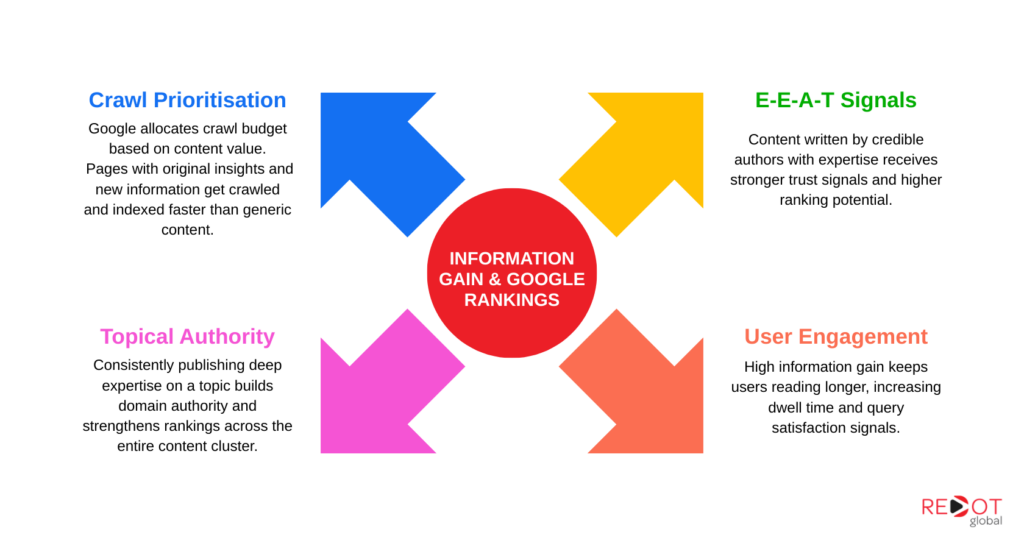
Crawl prioritisation and indexation speed. Google allocates a crawl budget to every domain, the number of URLs it is willing to crawl within a given window. According to Google’s crawl budget documentation, pages may not appear in search results even if crawled, if there is not sufficient value or user demand for the content. High information gain content is perceived as higher value, which means Googlebot allocates more crawl frequency to it. A page that adds nothing new to the web gets crawled less often, indexed more slowly, and surfaced less reliably than a page that adds genuinely original insight. For competitive businesses publishing time-sensitive analysis or client results, this crawl prioritisation gap directly affects how quickly new content becomes visible in organic search.
E-E-A-T scoring at the page and author level. Google’s E-E-A-T framework, covering Experience, Expertise, Authoritativeness, and Trustworthiness, is essentially information gain evaluated at the author and domain level rather than the content level alone. A page written by a named author with a verifiable publication history in the relevant domain receives stronger E-E-A-T signals than an anonymously published page, even if both pages contain the same content. The February 2026 core update reinforced this directly by rewarding sites with named authors and verifiable credentials while penalising anonymous content regardless of quality. Information gain and E-E-A-T are not separate requirements. They are the same requirement measured at different scales.
The full E-E-A-T implementation framework, covering author entity building, Person schema, editorial standards, and YMYL compliance, is covered in our E-E-A-T authority guide.
User engagement signals as downstream confirmation. When content contains genuine information gain, readers stay longer, return more frequently, and do not immediately return to Google to search again, a behaviour Google interprets as query satisfaction. These engagement signals, including dwell time, return visit rate, and low pogo-sticking, are downstream consequences of high information gain content. Google’s systems use them as confirmation signals that reinforce initial ranking decisions. Generic content that restates what readers already know produces the opposite pattern: readers scan briefly, find nothing new, and leave. Google’s systems read that pattern as a signal that the page did not satisfy the query.
Topical authority at the domain level. Google evaluates topical authority not just at the page level but across an entire content cluster. A domain that consistently publishes high information gain content on a specific topic builds what Google’s systems interpret as genuine subject matter expertise. This cluster-level authority signal compounds over time: each new piece of high information gain content reinforces the authority of every existing piece on the same topic. Generic content published at volume has the opposite effect, diluting topical authority by signalling to Google that the domain publishes broadly rather than deeply.
Where traditional rankings and AI citations diverge
The mechanisms differ at the point of selection. In traditional Google search, information gain improves ranking position within the organic results. In AI retrieval systems, information gain determines whether a page is selected as a citation source at all, regardless of its ranking position.
A page can rank in the top three for a keyword and still receive zero AI citations if its content lacks the structural extractability, entity density, and standalone answer architecture that AI retrieval systems require. Equally, a page ranking outside the top ten can be cited in AI Overviews if it contains a specific, verifiable data point that no higher-ranking page provides.
This divergence is why optimising for information gain at the content level addresses both outcomes simultaneously. The five signals covered in this post, proprietary data, first-person specificity, verifiable claims, non-obvious conclusions, and depth that anticipates follow-up questions, are the same signals that improve traditional rankings through E-E-A-T, crawl prioritisation, and user engagement, and that improve AI citation eligibility through entity density, structural extractability, and retrieval confidence. The mechanics are different. The content requirements are the same.
The February 2026 core update: what changed
Google confirmed the rollout of its February 2026 Discover core update between February 5 and February 27, with parallel ranking volatility reported across organic search throughout the same period. Analysis of sites affected during this window confirmed three specific patterns in which sites gained and which lost visibility.
Sites that gained rankings shared these characteristics: named authors with verifiable credentials, content built around first-person experience and proprietary data, and topical depth that covered a subject from multiple angles rather than surface-level keyword coverage.
Sites that lost rankings shared these characteristics: AI-generated content published at volume with minimal human editorial oversight, aggregated content that reorganised existing information without adding original analysis, and anonymous pages without author attribution or verifiable expertise signals.
The February 2026 update is not an isolated event. It is the latest in a consistent direction Google has taken since the September 2024 Helpful Content recovery update. The trajectory is clear: information gain is becoming the primary differentiator between content that ranks and content that does not.
What are the five signals of high information gain content?
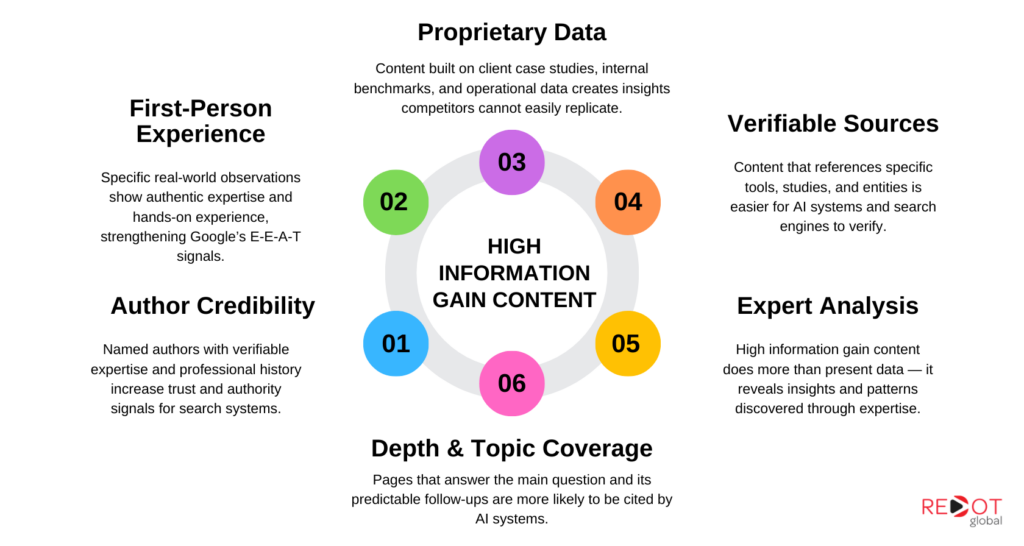
Not all original content generates equal information gain. The following five signals are the most consistently rewarded by both Google’s ranking systems and AI retrieval evaluation.
1. Proprietary data and original research
Content built on data that only you possess cannot be replicated. Client case studies with specific outcomes, internal benchmark data from real projects, and original analysis of your own operational experience all qualify.
Redot Global client result: e-commerce SEO
- 500+ keywords ranking on page one from zero visibility
- 7x increase in organic website traffic
- 10x increase in revenue in four months
This outcome is information gain no competitor can fabricate because no competitor ran that campaign.
Proprietary data does not require a formal research budget. It requires deliberate documentation of outcomes your team is already producing. Every client engagement contains information gain material. Most agencies never extract it.
2. First-person experience with specificity
Specificity is the signal that separates genuine experience from fabricated expertise. Vague claims like ‘website speed affects rankings’ are invisible to AI systems.
Specific observations like ‘in multi-regional AWS environments serving Southeast Asia through ap-southeast-1, TTFB exceeding Google’s Poor threshold of 1,800ms consistently correlates with failing LCP scores and measurable crawl efficiency losses’ are citable because they are precise, attributable, and verifiable. The entity is named. The threshold is defined. The consequence is stated. That is a citable claim.
Google’s E-E-A-T framework explicitly rewards the first E, Experience, as a distinct signal from Expertise. Experience means demonstrable evidence that the author has personally encountered the situation being described. The author bio is not decoration. It is an E-E-A-T verification mechanism.
3. Verifiable claims with named sources
Research from Growth Memo’s analysis of 1.2 million ChatGPT citations found that heavily cited content has an entity density of 20.6%, compared to 5-8% in standard English text. Entity density refers to the proportion of proper nouns, brand names, tools, people, and named concepts in a piece of content. AI systems cite content that references verifiable entities because named entities can be cross-checked against the knowledge graph.
Replace generic references with specific ones. Not ‘a major cloud provider’ but ‘AWS CloudFront.’ Not ‘a recent study’ but ‘Growth Memo’s February 2026 analysis of 1.2 million ChatGPT citations.’ Named entities are verifiable. Generic references are not. AI systems cite the verifiable.
4. Non-obvious conclusions from original analysis
High information gain content does not just present data. It draws conclusions that require expertise to reach. Core Web Vitals benchmarks are available on web.dev. An analysis of why AWS CloudFront misconfiguration is the most common cause of TTFB failures in Singapore’s ap-southeast-1 multi-regional hosting environments is not available anywhere except from engineers who have diagnosed it repeatedly.
The non-obvious conclusion is the information gain. The data alone is not. Publishing a table of benchmarks any reader could find on Google is low information gain. Publishing the pattern you have observed across 50 client audits of those benchmarks is high information gain.
5. Depth that anticipates follow-up questions
AI systems that process queries using query fan-out, where the user’s question is decomposed into multiple sub-questions before retrieval, favour pages that address the primary question and its adjacent questions in the same document. A page that answers one dimension of a topic forces the AI to source from multiple documents. A page that answers the primary question and its five most predictable follow-ups is more likely to be the sole or primary citation.
Anticipating follow-up questions means identifying what a reader would search next and answering it with the same depth as the primary question. This is not padding. Padding is restating the same point at greater length.
BLUF architecture: why your most important insight must come first
Bottom Line Up Front is not a writing style preference. It is an AI citation requirement.
Growth Memo’s analysis of 18,012 verified citations from 1.2 million ChatGPT responses found a “ski ramp” distribution in citation positional patterns:
- 44.2% of all LLM citations come from the first 30% of content
- 31.1% come from the middle 30-70% of content
- 24.7% come from the final 30% of content
The explanation is architectural. LLMs are trained on journalism and academic papers, both of which follow BLUF structure. The model has learned that the most authoritative, most densely informative content appears at the top of a document. It applies that learned pattern when evaluating what to extract and cite.
The practical consequence is severe for content structured in the traditional “build up to the point” format. An article that spends its first 600 words establishing context and arrives at its core insight in paragraph eight is structurally disadvantaged in every AI retrieval system. The insight may be genuinely original. The analysis may be excellent. But 44% of citation opportunity has already passed by the time the reader reaches it.
The Growth Memo research also found that 78.4% of citations containing questions come from headings. AI systems treat your H2 tag as the user’s query and the paragraph immediately following it as the answer. This makes the heading-to-opening-paragraph relationship the single most important structural unit in your content for AI citation purposes.
How do you apply BLUF in content writing?
State the core answer in the first paragraph of every section, not the last. Open H2 and H3 sections with the direct answer to the implied question, then follow with supporting evidence, context, and nuance. A reader who reads only the first sentence of each section should walk away with the essential insight of the entire post.
Apply BLUF at the brief stage, not the editing stage. Waiting until editing to restructure for BLUF means rewriting entire posts. A brief that specifies ‘what is the first sentence of each section?’ before writing begins produces BLUF-compliant content from the first draft.
How to structure content for AI extraction
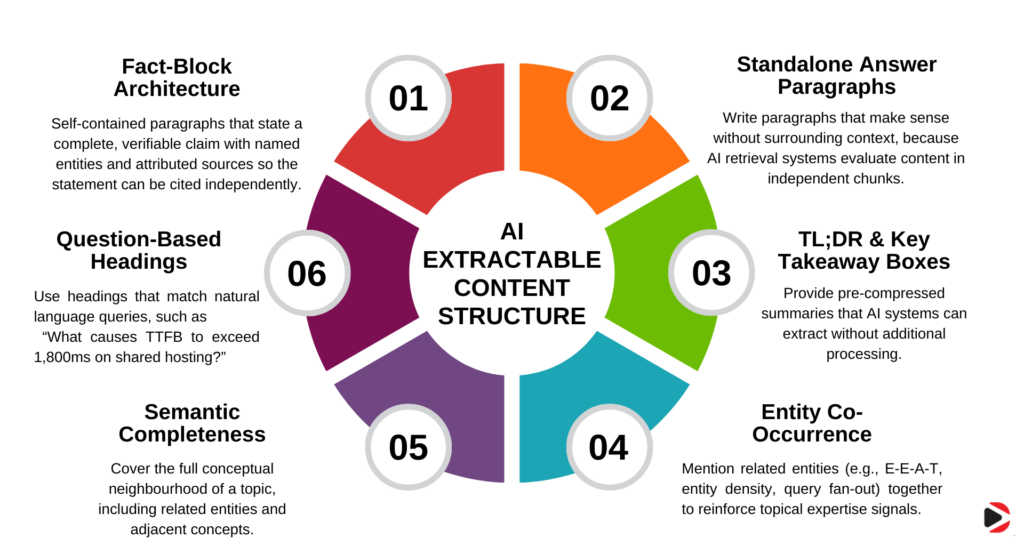
Information gain without structural accessibility is wasted. A page can contain genuinely original insights and still receive zero AI citations if those insights are not structured in a way that AI retrieval systems can extract. The following structural principles apply directly to citation eligibility.
Fact-block architecture
A fact-block is a self-contained paragraph that makes a complete, citable claim without requiring surrounding context to be understood. It names a specific entity, states a specific finding, and attributes it to a verifiable source. Every section of a high-information-gain post should contain at least one fact-block that would make complete sense if extracted and presented as a standalone citation in an AI-generated answer.
A fact-block that cites a specific outcome, names the tool or system involved, and attributes it to a verified source is extractable. A paragraph that says ‘improving your website speed will help your rankings’ is not. The difference is specificity, attribution, and self-containment.
Standalone answer paragraphs
Standalone answer paragraphs are written with the assumption that they will be read in isolation. They do not reference ‘as mentioned above’ or assume the reader has the preceding section in memory. AI retrieval systems chunk content into segments and evaluate each chunk independently. Paragraphs that depend on context established elsewhere in the post score lower on extractability.
Question-based headings
H2 and H3 headings phrased as the actual question a user would ask align directly with conversational query patterns. A heading like ‘What causes TTFB to exceed 1,800ms on shared hosting?’ tells the retrieval algorithm exactly what the following content answers. A heading like ‘Server Performance Considerations’ does not. The more precisely a heading matches a natural language query, the higher its citation eligibility.
TL;DR sections and key takeaway boxes
Pre-compressed summaries are among the most frequently extracted content elements in AI Overviews. They present information in a format the AI does not need to further condense, which reduces the processing required for citation and increases the probability of selection. Every post over 2,000 words should include a key takeaway box positioned at the top of the content, not the bottom.
Semantic completeness as a citation signal
Semantic SEO is the practice of building content around conceptual relationships, not just keywords. In the context of information gain and AI citation, semantic completeness is the degree to which a page addresses the full conceptual neighbourhood of its primary topic. It is one of the most underestimated citation multipliers in content strategy.
AI retrieval systems evaluate citation confidence, meaning how confident the AI is that a page is authoritative on the topic it is being asked about. A page that addresses the primary topic but leaves adjacent concepts unaddressed forces the AI to cross-reference multiple sources before it can construct a complete answer. A page that addresses the primary topic and its conceptually adjacent concepts in the same document increases retrieval confidence and citation probability.
Entity co-occurrence is the mechanism. When a page about information gain also correctly addresses E-E-A-T, entity density, query fan-out, and topical authority, those entities occur in proximity to each other. AI knowledge graphs interpret co-occurring entities as evidence of genuine subject matter expertise. A page that mentions only the primary topic keyword without its semantic neighbours signals narrow or shallow coverage to the retrieval system, even if the primary topic is covered at depth.
Topical completeness signals work at two levels. At the page level, every H2 section should cover its sub-topic thoroughly enough that it could stand as a short post independently. At the cluster level, the relationship between your pillar page and its cluster posts creates a semantic map that AI systems interpret as topical authority at domain scale. A single well-written post is a citable document. A coherent cluster of well-written posts on related topics is a citable authority.
The practical process: before finalising any post outline, list the ten concepts most semantically adjacent to your primary topic. Identify which you address directly and which you leave out. For each concept left out, ask whether its absence weakens the page’s ability to answer the primary question completely. If it does, either add it to the post or ensure it is addressed in a linked cluster with a clear internal link from this page.
Semantic completeness does not mean covering everything. It means covering everything a knowledgeable reader would expect to see addressed by someone who genuinely understands the topic. The test is not ‘have I mentioned this concept’ but ‘have I addressed it with enough depth that an AI reading this page would consider my coverage of it authoritative.’
How Redot applies information gain in practice
Every piece of content Redot Global publishes for clients goes through a pre-writing information gain audit before a single word of body copy is written. The audit answers four questions.
First: what does this content know that no other published content knows? If the answer is nothing, the brief is sent back for revision. Generic briefs produce generic content. The audit forces the content owner to identify the proprietary insight before writing begins.
Second: what specific data, case study outcomes, or first-person observations will this post contain that cannot be found elsewhere? The answer to this question becomes the fact-blocks that anchor the post’s citation potential.
Third: what is the core answer this post delivers, and is that answer in the first paragraph of every section? BLUF is applied at the brief stage. The outline specifies the opening sentence of each H2 before the draft begins.
Fourth: what are the five follow-up questions a reader would ask after reading this post, and does the post address them? If not, those answers are added before the draft is considered complete. This is the semantic completeness audit applied at the brief level.
This process is why the content cluster you are reading now is structured the way it is. Each post delivers a specific dimension of the framework at exhaustive depth, linking to the others for adjacent dimensions, and together they constitute a complete technical brief for building a citation-visible digital presence in 2026.
Conclusion
The rules that determined content quality in 2020 and the rules that determine it in 2026 are not the same rules. Keyword coverage, comprehensive topic treatment, and word count were once sufficient signals of quality. They are no longer sufficient because they are no longer scarce. Every AI-assisted content operation on the planet can produce comprehensive, keyword-rich, long-form content in minutes. Scarcity has moved upstream.
What is scarce in 2026 is the insight that cannot be generated from existing web text because it does not yet exist on the web. The first-person observation from a practitioner who has run the campaign, diagnosed the infrastructure fault, or managed the client account. The proprietary data point from an operation that has documented its outcomes. The non-obvious conclusion that requires genuine expertise to reach.
Information gain is not a content tactic. It is the natural output of teams that have something original to say and the discipline to say it in a structure that AI retrieval systems can extract, evaluate, and cite. BLUF architecture, entity density, semantic completeness, and fact-block structure are not constraints on good writing. They are the structural expression of what good writing already does when it is genuinely authoritative.
If you are auditing your current content against these principles, the question to ask is not ‘is this well-written.’ The question is ‘does this post know something that no other post knows.’ If the answer is no, the post needs more than editing. It needs a genuine insight at its centre before the structure can do its work.
Redot Global builds content strategies around this principle for clients across Singapore, Canada, and Germany. If your current content is well-structured but not producing rankings or AI citations, the infrastructure is working correctly. The insight is missing.
Ready to put information gain to work for your business?
Most content audits review what you have already published. Redot Global’s content strategy engagements start at the brief level, identifying the information gain gaps that prevent content from ranking in Google search and getting cited by AI systems before a word is written.
If your current content is well-structured but not producing organic rankings or AI citations, the problem is upstream.
Frequently asked questions
What is information gain in SEO?
Information gain in SEO is the measure of genuinely new and unique insight a piece of content adds to the existing web. Google’s systems compare new content against the existing corpus and assess whether it introduces original data, first-person observations, or non-obvious conclusions not already present in similar or identical form elsewhere. High information gain content earns rankings and AI citations. Low information gain content, even if well-written, is treated as redundant and receives reduced visibility.
Does information gain affect traditional Google rankings or only AI citations?
Information gain affects both, through different but reinforcing mechanisms. In traditional Google search, it influences crawl prioritisation, E-E-A-T scoring, user engagement signals, and topical authority at the domain level. In AI retrieval systems, it determines whether a page is selected as a citation source based on entity density, structural extractability, and retrieval confidence. The content requirements that improve traditional rankings, named sources, specific data, first-person expertise, and non-obvious conclusions, are the same requirements that improve AI citation eligibility. Optimising for one optimises for the other.
How does Google detect thin or low-information-gain content?
Google’s systems evaluate content quality through multiple signals including content similarity analysis, E-E-A-T verification, user engagement patterns, and the presence or absence of original data and named entity references. The February 2026 core update increased the weighting of information gain specifically, meaning pages that aggregate or repackage existing information without adding original analysis now face more consistent ranking pressure than in previous years.
Does AI-generated content hurt rankings in 2026?
AI-generated content does not automatically hurt rankings. Google’s February 2026 core update made a specific distinction: AI content used as a tool to support human expertise performs well. AI content published at volume with minimal human editorial oversight and no original analysis performs poorly. The quality of the insight matters more than how the content was produced. The problem with most AI-generated content is not that it was written by AI. It is that it lacks information gain.
How long should a high-information-gain post be?
Length should be determined by the number of genuine insights the post contains, not by a target word count. A 1,500-word post containing five specific, citable, original insights outperforms a 4,000-word post containing three. Write until you have exhausted your original insights. Stop before you start repeating yourself.
What is BLUF formatting and why does it matter for SEO?
BLUF stands for Bottom Line Up Front. It is a writing structure that states the core answer at the beginning of a section rather than building to it. Research from Growth Memo’s analysis of 1.2 million ChatGPT citations found that 44.2% of all LLM citations come from the first 30% of content. Content structured to place its most important insights in the opening paragraph of each H2 and H3 is structurally advantaged in AI retrieval systems compared to content that buries its conclusions.
What is entity density and how do I improve it?
Entity density is the proportion of proper nouns, brand names, tools, people, locations, and named concepts in a piece of content. Research from Growth Memo found that heavily cited content has an entity density of approximately 20.6%, compared to 5-8% in standard English text. To improve entity density, replace generic references with specific named ones. Instead of ‘a leading cloud provider,’ write ‘Amazon Web Services.’ Instead of ‘recent research,’ write ‘Growth Memo’s February 2026 analysis of 1.2 million ChatGPT citations.’ Named entities are verifiable. Generic references are not.
What is semantic completeness and how does it affect AI citations?
Semantic completeness is the degree to which a page addresses the full conceptual neighbourhood of its primary topic. AI retrieval systems evaluate citation confidence based on whether a page addresses adjacent concepts in addition to the primary topic. A page that mentions only the primary topic without its semantic neighbours signals shallow coverage to the retrieval system, even if the primary content is excellent. Audit your post outline against the ten most conceptually adjacent topics and ensure the most important adjacent concepts are addressed at sufficient depth within the same document or linked directly from it.
How do I measure whether my content has sufficient information gain?
Before publishing, ask four questions: Does this post contain data or observations that cannot be found in identical form elsewhere? Is the core answer stated in the first paragraph of each section? Does every H2 section contain at least one standalone fact-block that makes complete sense as a citation excerpt? Does the post address the five follow-up questions a reader would naturally ask after reading it? If the answer to any of these is no, the post needs revision before publication.

Head of Digital Marketing, Redot Global
Kasun Asiri is a Digital Marketing Strategist with over 15 years of experience delivering high-impact digital growth initiatives across global markets. At Redot Global, he plays a key role in planning and executing performance-driven campaigns for international brands, consistently achieving measurable results through advanced SEO, Google Ads, and integrated digital visibility strategies. With deep expertise at the intersection of marketing, technology, and data, he specialises in building scalable growth systems powered by data science and AI-driven automation, transforming traditional marketing into efficient, data-driven frameworks designed to drive sustainable business growth. His work is defined by analytical thinking, strategic execution, and a commitment to delivering performance-focused solutions that align with business goals and long-term success.