


The 2026 Definition: The “Zero-Click” Answer
The SGE Snippet (Optimised for AI Overviews)
In 2026, SEO is the process of optimising a digital entity’s visibility through technical infrastructure, information gain, and user-intent alignment, ensuring that AI systems, search engines, and human users can find, trust, and act on your content across every surface where decisions are made.
That is the definition. Fifty words. Structured for Google’s AI Overview to extract, cite, and surface. And if you just read it thinking it sounds like a mouthful, that is precisely the point. Search engine optimization in 2026 is not a single thing anymore. It is an engineering discipline, a trust architecture, and a long-game brand strategy rolled into one.
Why the Old “Keywords and Backlinks” Definition is Dead
Not long ago, the working definition of SEO was simple: find the right keywords, build some backlinks, and watch traffic roll in. That model had a good run. It is now retired. Not gradually phased out, but fundamentally broken by a structural shift in how people search and how AI systems answer them.
Here is the data that makes this undeniable: according to Similarweb, more than 60% of all Google searches in 2026 end without a single click to any external website. The answer is delivered directly in the search interface, through AI Overviews, featured snippets, knowledge panels, and People Also Ask boxes. And it gets more extreme when you zoom in on AI-native search behaviour: around 93% of Google AI Mode searches end without a click, according to Semrush data from September 2025. Let that land for a moment. Nine out of ten users who interact with AI-powered search never visit the site that the AI cited.
Meanwhile, organic click-through rates for queries featuring Google’s AI Overviews have dropped by 61% since mid-2024, falling from 1.76% to just 0.61%. For paid search, the damage is even sharper, with a 68% decline in CTR over the same period.
If you are still optimising a website purely for “position one on Google,” you are competing for a prize that now reaches fewer and fewer people. The question in 2026 is not where do you rank but rather does Google’s AI trust you enough to cite you.
That is an entirely different problem, and it requires an entirely different solution.
The Redot Perspective: SEO as a Digital Asset
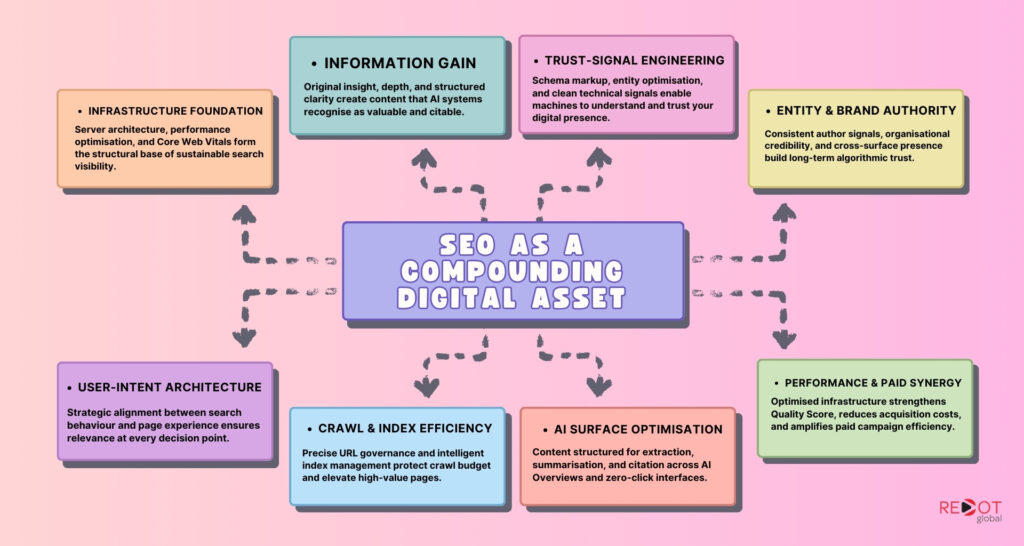
The “Asset-Building” Framework
At Redot Global, we do not view SEO as a monthly service you bolt onto your existing website. We treat it as the construction of a permanent digital asset, something that appreciates in value over time, generates compounding returns, and cannot be easily replicated by competitors because it is built on infrastructure, data, and earned authority rather than tactics.
The analogy is straightforward. A physical property generates rental income long after construction is complete. A well-engineered digital presence, built on fast infrastructure, structured data, authoritative content, and technical excellence, generates organic traffic and AI citations long after the initial work is done. The difference between a website and a digital asset is the same as the difference between renting a room and owning a building.
Our approach integrates four dimensions that most agencies treat in isolation: technical infrastructure, content with unique information value, user-intent architecture, and trust-signal engineering. Together, they compound.
The Inefficiency Tax: How Poor SEO Silently Destroys Your Paid Ads Budget
Here is a hidden cost that almost nobody talks about: a poorly optimised website is a tax on everything else you spend in marketing.
Your Google Ads Quality Score, the metric Google uses to determine how much you pay per click, is directly influenced by your landing page experience. A slow, poorly structured page with weak relevance signals drives your Quality Score down and your Cost Per Click up. You pay more for the same click, and convert less of the traffic you get.
In practice, we see clients who are spending $5,000 to $15,000 per month on paid search while their technical infrastructure is silently eroding that investment. Their server response times are exceeding Google’s Poor threshold of 1,800ms. Their Interaction to Next Paint (INP) scores are failing. Their schema markup is missing or malformed. Their crawl budget is being wasted on thousands of low-value URLs generated by faceted navigation. Every dollar of paid spend is working at 60 cents of efficiency because the underlying digital asset is leaking.
Fix the infrastructure, and your SEM performance improves without increasing budget. That is the Redot approach: organic and paid do not operate in separate silos; they share the same technical foundation.
The Cost of Inaction
While most businesses categorise a slow server response as a minor technical issue, the underlying mathematics tell a different story. Based on our infrastructure audits for multi-regional AWS environments, legacy technical debt acts as a compounding tax that devalues every marketing dollar before it even reaches a user.
When infrastructure fails, your marketing efficiency does not just slow down. It leaks.
Performance Vector | Impact on Marketing ROI | Revenue Leakage Simulation |
TTFB above 1,800ms | ~22% Crawl Efficiency Loss | New revenue pages remain unknown to Google for weeks, delaying time-to-market. |
Failing INP | 7-10% Conversion Decay | For every SGD 100,000 in potential revenue, SGD 10,000 is lost to interaction friction on mid-range devices. |
Low Quality Score | Up to 25% CPC premium at Quality Score 4 | You pay a penalty on every Google Ads click, subsidising competitors with better infrastructure. |
The Redot Engineering Verdict: You cannot out-spend a broken foundation. When we remediate the infrastructure layer, we are not just speeding up a site. We are recovering the digital ROI that was being silently consumed by the Inefficiency Tax.
Read the Full Technical Breakdown: The Inefficiency Tax and Your Digital ROI →
Real-World Insight from Managing Multi-Regional AWS Environments
In our experience managing multi-regional AWS environments for clients across Singapore, Canada, and Germany, one observation consistently holds true: server response time is the single most underestimated SEO variable.
When we audit a new client’s environment, we routinely find that their Time to First Byte (TTFB) is exceeding Google’s Poor threshold of 1,800ms, not because their content is heavy, but because their server architecture is inefficient. Misconfigured CloudFront distributions, oversized EC2 instances without proper auto-scaling, and the absence of edge caching are bleeding performance before a single byte of content reaches the user’s browser.
The compounding effect is significant: a TTFB above 1,800ms consistently correlates with a failing LCP (Largest Contentful Paint) score, which is a confirmed Core Web Vitals ranking factor. Meanwhile, Google’s crawlers, constrained by crawl budget, waste allocation on slow-loading pages and surface fewer URLs for indexing.
When we optimise the infrastructure layer, tightening server response, enabling proper CDN caching, and right-sizing compute resources, we routinely see a 30 to 50% improvement in Core Web Vitals scores before touching a single line of application code. The SEO impact follows within four to eight weeks of Google’s 28-day rolling field data window updating.
The lesson is clear: for enterprise-grade websites, infrastructure is not an IT concern. It is an SEO concern.
Pillar 1: Technical and Infrastructure SEO
Technical SEO in 2026 is software engineering. The two are inseparable, and any agency that does not have genuine engineering capability is delivering SEO with one hand tied behind its back.
Core Web Vitals: INP is Now the Battlefield
Google replaced First Input Delay (FID) with Interaction to Next Paint (INP) as the responsiveness metric in March 2024, and in 2026 it is the metric where most competitive websites are still failing. INP measures the full time from a user’s interaction, a click, a tap, a keypress, to the moment the browser displays a visual response. The threshold for a “good” INP score is under 200 milliseconds.
What fails INP? The usual culprit is JavaScript. Long-running scripts that block the main thread prevent the browser from responding to user interactions. In React and other heavy SPA frameworks, the main thread gets monopolised by hydration and re-rendering cycles. The solution requires genuine engineering: breaking tasks into asynchronous chunks, implementing “Island Architecture” (where only interactive components are hydrated rather than the entire page), and aggressively auditing third-party scripts from analytics platforms, advertising tags, and social widgets.
For context: a 100-millisecond delay in page load time can reduce conversions by 7%, according to Akamai’s State of Online Retail Performance report. Poor INP directly causes hesitation, distrust, and abandonment, all of which feed back into Google’s user experience signals.
Schema Markup: The Language AI Systems Speak
If Core Web Vitals are about how your site performs, Schema.org structured data is about how AI systems understand your site. In an era where Google’s AI Overviews aggregate and synthesise content from multiple sources, structured data is the markup language that signals to machines: “this is what this content is, this is who wrote it, this is what it means.”
For modern SEO, essential schema types include: Article, FAQPage, HowTo, Dataset, Person (for author profiles), Organisation, and BreadcrumbList. Each type tells a different part of the story, and collectively they make your content extractable and citable by AI systems.
The December 2025 Rendering Update from Google added further urgency: pages returning non-200 HTTP status codes may now be excluded from the rendering pipeline entirely, meaning Googlebot may never process your content even if it is technically crawled.
Crawl Budget and Index Management
Google does not have unlimited appetite for your website. It allocates a crawl budget, the number of URLs it is willing to crawl within a given window, and sites that waste it on low-value pages see fewer high-value pages indexed and ranked.
Common crawl budget killers include session IDs in URLs, faceted navigation generating millions of URL combinations, thin paginated pages, and misconfigured canonicals. A site with 1,000 products can inadvertently generate 1,000,000 low-value URLs through filter combinations. This “combinatorial explosion” problem is one of the most damaging and least understood issues in e-commerce SEO.
The solution is architectural: clean URL structures, aggressive robots.txt governance, XML sitemaps that contain only indexable high-value pages, and canonical tags applied with precision. In 2026, the most efficient site is not the one with the most pages indexed. It is the one with the highest ratio of quality pages to total pages.
Pillar 2: Information Gain and Content Strategy
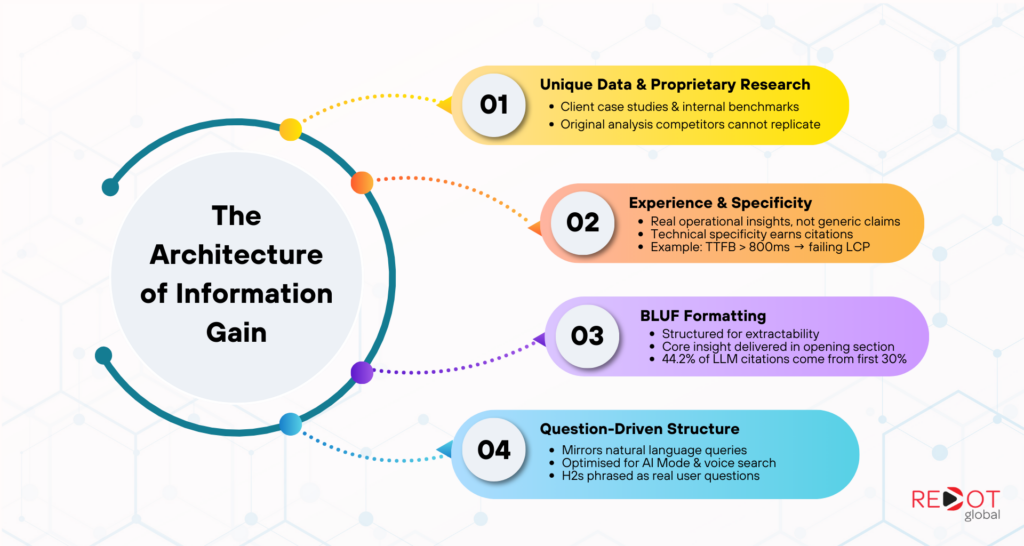
Google’s systems have become extraordinarily good at identifying whether a piece of content adds genuine new information to the web or merely recombines what already exists. This concept, often described as “information gain,” is a key differentiator between content that earns AI citations and content that is ignored.
The landscape has been flooded with AI-generated content. By 2026, the sheer volume of generic, machine-produced text has created a paradox: AI-generated content is everywhere, and it has made human differentiation more valuable than ever. The more generic content fills the internet, the more Google’s systems reward genuine insight, original data, and verifiable expertise.
What wins in this environment:
Unique data and proprietary research. Content based on your own client results, internal benchmarks, or original analysis cannot be replicated because no one else has the same dataset.When Redot Global took starlightjewellery.com.sg from zero page-one visibility to 500+ keywords ranking on the first page, achieving a 7x increase in website traffic and 10x escalation in revenue in four months, that is information gain no competitor can fabricate.
First-person experience and specificity. AI systems, and increasingly Google’s E-E-A-T evaluation framework, reward content written by people who have demonstrably done the thing they are writing about. Specificity is the signal. Vague claims like “improve your website performance” are invisible to AI systems; specific insights like “in multi-regional AWS environments, TTFB above 1800ms consistently correlates with failing LCP scores” are citable.
BLUF formatting: Bottom Line Up Front. Research from Growth Memo confirms that 44.2% of all LLM citations come from the first 30% of an article. Getting your most important insight out early is not just good writing. It is AI optimisation. Structure content so the core answer is in the opening section, with supporting depth below.
Question-based headings that mirror natural language queries. AI Mode and voice search are dialogue-based. Users ask questions conversationally. Content structured around real questions, including H2s phrased as questions, aligns with the way AI systems scan for extractable answers.
The full implementation framework for producing and structuring high information gain content, including fact-block architecture, entity density, semantic completeness, and BLUF structure, is covered in our information gain content strategy guide.
Pillar 3: User Intent and SGE Optimisation
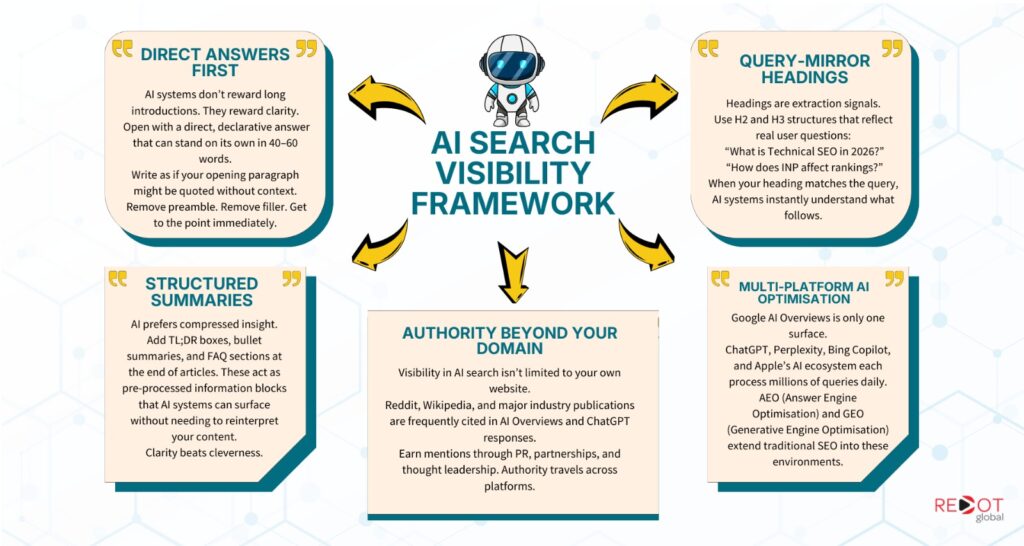
Google’s Search Generative Experience (SGE), now expressed through AI Overviews and AI Mode, has fundamentally changed the competitive landscape. The goal is no longer just to rank. It is to become a source that AI trusts enough to cite.
This distinction matters because the economics of being cited are entirely different from the economics of ranking. When your brand is cited in an AI Overview, you achieve top-of-SERP visibility and build authority even when users do not click through. Third-party earned sources consistently outweigh brand-owned domain citations across ChatGPT, Gemini, and Perplexity, meaning your off-site presence, including PR coverage, industry mentions, and authoritative reviews, now directly contributes to your AI visibility.
The full technical breakdown of how AI retrieval systems select sources, and how to engineer your content to be cited, is covered in our Citation Economy guide to GEO, AEO and SGE.
To optimise for SGE and AI search:
Answer questions directly and concisely. AI systems extract specific, declarative sentences. Write your content so that the answer to a query can be lifted as a standalone 40 to 60 word paragraph. Avoid preamble. Get to the point.
Use H2 and H3 headings that mirror user queries. AI extraction algorithms identify sections by their headings. A heading like “What is Technical SEO in 2026?” signals exactly what the following content will answer.
Include TL;DR sections and structured summaries. Key takeaway boxes, bullet-point summaries, and FAQ sections at the end of articles perform disproportionately well in AI citation because they present pre-compressed information that AI systems can surface without further processing.
Build authority across platforms, not just your own domain. Reddit, Wikipedia, and major industry publications are among the most frequently cited domains in AI Overviews and ChatGPT responses. Getting your brand mentioned in authoritative third-party sources, through PR, thought leadership contributions, and industry partnerships, expands your AI visibility surface.
Optimise for multi-platform AI search. Google AI Overviews is only one channel. ChatGPT alone has surpassed 900 million weekly active users as of February 2026, with users sending over 2.5 billion messages per day. Perplexity, Bing Copilot, and Apple’s AI integrations each represent distinct audiences with different citation preferences and content formats. Optimising for one platform is no longer sufficient. AEO (Answer Engine Optimisation), GEO (Generative Engine Optimisation), and SGE optimisation are the 2026 disciplines that extend traditional SEO into these new surfaces, and our Citation Economy guide covers the full implementation framework for all three.
Pillar 4: E-E-A-T and the Trust Architecture

Google’s E-E-A-T framework, standing for Experience, Expertise, Authoritativeness, and Trustworthiness, has evolved from a quality guideline into the backbone of how the algorithm evaluates which sources deserve to be cited, ranked, and surfaced to users.
Critically, Google trusts people, not just pages. The author of a piece of content now carries as much weight as the domain it is published on. A technically authoritative article about AWS infrastructure written by a named engineer with a verifiable career history, linked Schema.org Person markup, and a consistent publication record across authoritative platforms will outperform an anonymously published article on a high-DA domain.
This shifts SEO strategy toward individual authority building:
Author profiles with substance. Every content contributor at your organisation should have a bio that demonstrates their credentials, including qualifications, years of experience, past work, and industry publications. This is not vanity; it is a ranking signal. Include Schema.org Person markup linking the author to their LinkedIn, research profiles, and relevant social accounts.
Visible editorial standards. An “Our Editorial Standards” or “How We Create Content” page, explaining your fact-checking process, source verification policy, and expert review protocol, signals institutional trustworthiness to Google’s quality raters and AI systems alike.
Third-party validation. Client reviews, industry certifications, press mentions, and case study data are trust signals. Redot Global’s status as a Certified Google Partner and AWS Network Partner in Singapore, combined with documented client results, is E-E-A-T in action. These are not just marketing claims. They are trust signals that Google’s systems can verify and factor into authority calculations.
YMYL content demands higher E-E-A-T investment. “Your Money or Your Life” content, covering health, finance, legal, and business advisory topics, faces the most rigorous trust evaluation. Any brand publishing in these categories without robust author credentials and external validation is at a significant disadvantage.
The full implementation framework for building E-E-A-T authority that Google and AI systems can verify, including author entity building, Person schema deployment, editorial standards, and YMYL compliance, is covered in our E-E-A-T authority guide.
Why Engineering is the Secret Weapon of Modern SEO
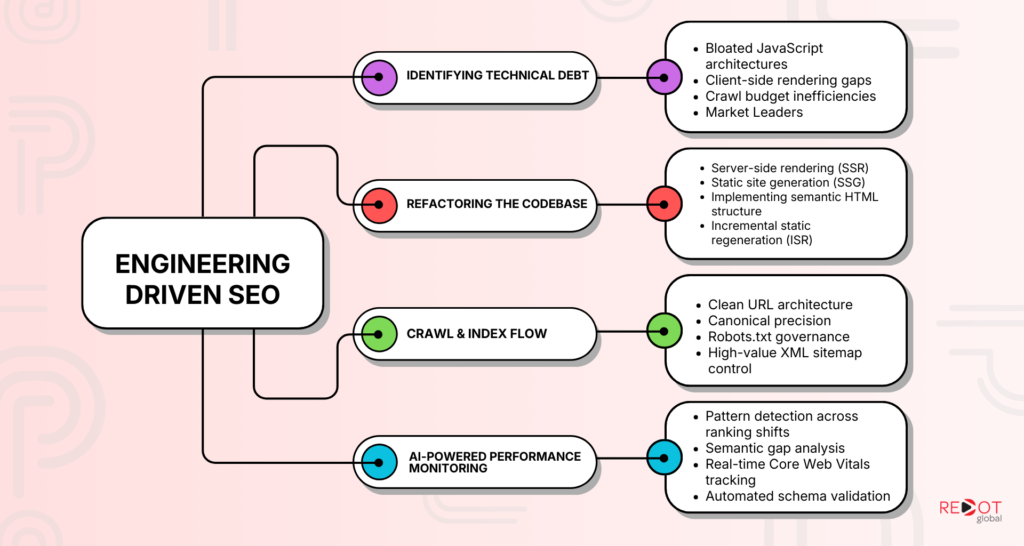
The Clean Code and Crawl Budget Connection
There is a direct, measurable relationship between code quality and search engine performance, and it is one of the most underappreciated aspects of technical SEO.
When Googlebot visits your website, it has a finite window of time and resources to allocate. Bloated code slows the crawl. JavaScript-heavy architectures that rely on client-side rendering mean Googlebot may never see your content because it processes JavaScript in a separate, lower-priority queue. Unnecessary redirects waste crawl allocation. Duplicate content generated by poor URL architecture dilutes index value.
A codebase built with clean, semantic HTML, properly structured with meaningful hierarchy, minimal render-blocking resources, and progressive enhancement principles, communicates efficiently with Googlebot. It maximises the value extracted from every crawl, ensures more pages are indexed at higher quality, and reduces the computational overhead that erodes performance scores.
At Redot Global, our full-stack development capability, spanning technologies including Laravel for robust backend architecture and React for performant front-end interfaces, means we design for SEO at the code level, not as an afterthought. Server-side rendering (SSR) and static site generation (SSG) approaches ensure content is rendered before Googlebot requests it, eliminating the JavaScript rendering gap that quietly undermines rankings for many modern web applications.
Incremental Static Regeneration (ISR), a hybrid architecture increasingly preferred for e-commerce in 2026, serves pre-rendered HTML at static speed while regenerating specific pages in the background when data changes. This delivers the performance scores Core Web Vitals demand, without sacrificing the content freshness that SEO requires.
Clean code is not just good engineering practice. In 2026, it is a direct competitive advantage in search.
How AI-Powered Analysis Delivers Insights Traditional Tools Miss
The SEO analytics gap is widening. Traditional keyword research tools, rank trackers, and crawl reports provide a rear-view mirror. They tell you what happened, not what is about to happen. AI-powered analysis changes the equation.
At Redot Global, our AI/ML capabilities, including AI-driven analytical SEO, allow us to process datasets at a scale and speed no human analyst can match. Pattern recognition across thousands of ranking fluctuations identifies algorithm sensitivity in real time. Semantic content analysis identifies gaps in topical coverage that are invisible to standard keyword tools. Predictive models flag pages with declining E-E-A-T signals before they experience ranking drops.
The competitive intelligence this generates is qualitatively different. Instead of reacting to ranking changes weeks after they happen, AI-powered analysis surfaces the signals that precede changes, allowing proactive optimisation rather than crisis management.
The practical output: faster identification of high-information-gain content opportunities, more accurate crawl budget prioritisation, real-time Core Web Vitals monitoring tied to business metrics, and automated detection of schema errors before they reach production.
Manual SEO is increasingly not a viable long-term approach. By 2026, the best-performing SEO operations run automated workflows for content auditing, error detection, and performance monitoring, with human expertise applied to strategy, creative direction, and interpretation of AI-generated insights, not routine data gathering.
Conclusion: The Long-Term ROI of Engineering-Grade SEO
There is a persistent myth in digital marketing that SEO is something you do once and then revisit occasionally. The reality of 2026 is the opposite: SEO is a living system that compounds over time, degrades when neglected, and rewards consistency far more than intensity.
The analogy we return to at Redot Global is that of a financial portfolio. Short-term traders chase peaks and absorb losses. Long-term investors build diversified positions, compound returns quietly over years, and outperform the market without the drama. SEO, engineered properly, behaves the same way.
A brand that invests in technical infrastructure, including server performance, clean code, and structured data, while simultaneously building genuine information authority through expert content and E-E-A-T signals, is constructing an asset that appreciates in value with each passing month. Its AI citation count grows. Its organic search share expands. Its Cost Per Acquisition through paid channels decreases because its Quality Scores improve. These are compounding returns, not linear ones.
The brands that will dominate search in 2026 and beyond are not the ones that chased every algorithm update with reactive tactics. They are the ones that built something worth finding, technically sound, informationally valuable, and genuinely trustworthy. They engineered their digital presence rather than rented it.
SEO in 2026 is a marathon with compound interest. The best time to start building was two years ago. The second best time is now
Ready to Engineer Your Digital Asset?
Redot Global’s Technical SEO and Infrastructure services are built for brands that understand SEO is not a marketing expense. It is a long-term investment in compounding digital equity.
As Singapore’s Certified Google Partner and AWS Network Partner, we bring genuine engineering capability to every campaign, from AWS server architecture and Core Web Vitals optimisation to AI-driven content strategy and E-E-A-T authority building.

Co-Founder and Director, Redot Global
Suneth Silva is the Co-Founder and Director of Redot Global, a Singapore-based technology company specialising in AI-driven digital marketing, enterprise software development, and business automation. He leads strategy across technical SEO, performance marketing, and marketing analytics while overseeing engineering teams building cloud-native platforms and AI-enabled systems. His work integrates machine learning, LLM development, semantic search, and predictive analytics to deliver measurable growth for clients across hospitality, automotive, retail, finance, and government. With a background spanning software engineering, systems architecture, and applied AI, Suneth focuses on building end-to-end digital ecosystems that unify technology, data, and strategy.