


Table of Contents
There is a competition happening right now that most Singapore businesses are not aware they are losing.
It is not a competition for position one on Google. It is a competition to be cited by AI systems that hundreds of millions of people use every day to answer questions, evaluate vendors, and make purchasing decisions. The rules of this competition are different from anything that traditional SEO prepared your business for. The metrics are different. The technical requirements are different. And the businesses winning it are not winning because they published more content or built more backlinks.
They are winning because they engineered their digital presence to be structurally selected by AI retrieval systems. That engineering discipline has three components: Generative Engine Optimisation (GEO), Answer Engine Optimisation (AEO), and Search Generative Experience (SGE) / AI Mode optimisation. Together, they constitute what we call the Citation Economy.
In our master guide on Search Engine Optimization in 2026, we introduced these three disciplines as Pillar Three of the modern SEO framework. This post delivers the full technical breakdown: what GEO, AEO and SGE actually mean at the implementation level, how AI systems decide which sources to cite, what your content architecture needs to look like, and why none of it works without a technically sound foundation.
Why Ranking Is No Longer the Objective
The data that makes this argument undeniable has been building for two years. According to Similarweb, zero-click searches grew from 56 percent to 69 percent of all Google searches between May 2024 and May 2025, driven by the expansion of AI Overviews. AI Overviews, featured snippets, knowledge panels, and People Also Ask boxes deliver the answer directly in the search interface before a user reaches any external website.
The effect is more extreme in AI-native search environments. Semrush data from July 2025 shows that approximately 92 to 94 percent of Google AI Mode sessions resolve without a click to any external site. For organic listings directly beneath AI Overviews, Search Engine Land reports that click-through rates declined by 61 percent since mid-2024, falling from 1.76 percent to 0.61 percent.
Position one on a traditional SERP now represents a fraction of the visibility it delivered three years ago. The question businesses must answer in 2026 is not where they rank but whether the AI systems their customers are using trust them enough to cite them as a source.
That is a structural question about how your content is built, how your brand is understood by AI knowledge systems, and whether your technical infrastructure permits AI crawlers to access and process your information at all. Ranking tactics do not answer it. Citation engineering does.
THE ZERO-CLICK REALITY FOR SINGAPORE BUSINESSES - If your business relies on organic search traffic and has not adapted to zero-click and AI-cited search, your effective search visibility is declining regardless of your rankings. The businesses maintaining revenue growth from organic in 2026 are the ones whose brands appear as cited sources inside AI Overviews, ChatGPT responses and Perplexity answers, not just as blue links below them.
How AI Systems Actually Select Sources: The RAG Pipeline
Â
Before engineering for AI citation, you need to understand the mechanism by which AI systems select their sources. Most content advice skips this step. The result is generic recommendations that do not address the actual selection criteria.
The dominant architecture behind AI search systems is Retrieval-Augmented Generation (RAG). RAG works in two phases. In the retrieval phase, the AI system queries a vector database or a search index to identify documents that are semantically relevant to the user’s query. In the generation phase, the language model reads the retrieved documents and synthesises a response, citing the sources it draws from.
Your content must survive the retrieval phase before it can ever appear in the generation phase. Retrieval is not the same as ranking. A page can rank well in traditional organic search and fail to be retrieved by an AI system because the content does not meet the structural and semantic requirements that retrieval algorithms apply.
What the Retrieval Phase Evaluates
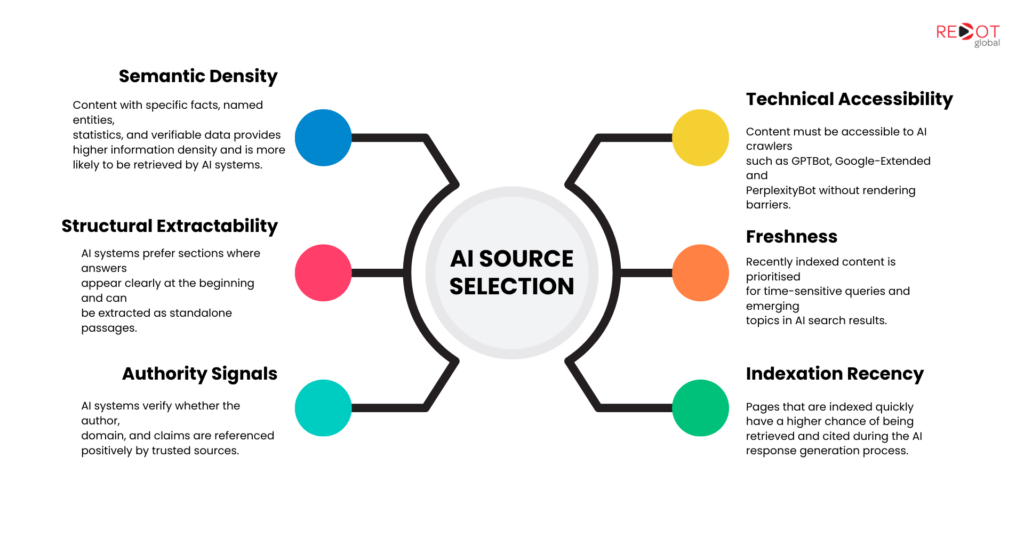
AI retrieval systems filter candidate documents against several criteria before they are passed to the generation model:
- Semantic density: How much specific, factual information is packed into the content. Vague explanatory content scores poorly. Content with named entities, verifiable statistics, specific processes, and declarative factual statements scores highly.
- Structural extractability: Whether the content’s answers can be lifted as standalone passages. A 400-word paragraph with a conclusion buried at the end is harder to extract than a section that opens with its core claim followed by supporting evidence.
- Authority signal verification: Whether the source domain, the author entity, and the content itself are referenced positively by other authoritative sources in the training data and live index. AI systems effectively run an authority check before selection.
- Technical accessibility: Whether AI crawlers (GPTBot, Google-Extended, PerplexityBot, ClaudeBot) can access, render, and parse the content. Content behind JavaScript rendering gaps, slow servers, or blocked crawlers simply does not exist to these systems.
- Freshness and indexation recency: AI search systems prioritise recently indexed content for time-sensitive queries. A page that takes two weeks to be indexed after publication has already missed the citation window for that news cycle.
Research published in the GEO benchmark study quantified the impact of content engineering on AI retrieval rates. Adding verifiable statistics, authoritative citations, and quotable declarative sentences increased a source’s visibility share in AI-generated responses by up to 40 percent compared to equivalent content lacking these structural signals.
The Three-Layer Citation Framework: GEO, AEO and SGE
The Citation Economy operates on three distinct but interdependent layers. Each layer addresses a different channel, a different AI system, and a different content engineering requirement. Optimising for one layer without the others leaves significant visibility on the table.
|
Layer
|
System
|
Primary Goal
|
Key Technical Requirement
|
|---|---|---|---|
|
GEO
|
LLMs (ChatGPT, Gemini, Claude)
|
Be selected as a source during RAG retrieval
|
Information density and fact-block architecture
|
|
AEO
|
Perplexity, Bing Copilot, Voice
|
Be the direct answer in conversational queries
|
Conversational long-tail structure and FAQ schema
|
|
SGE / AI Mode
|
Google AI Overviews
|
Be cited inside Google's AI-generated answers
|
Topical completeness and E-E-A-T trust signals
|
Layer 1: Generative Engine Optimisation (GEO)
Engineering Information Gain at the Content Level

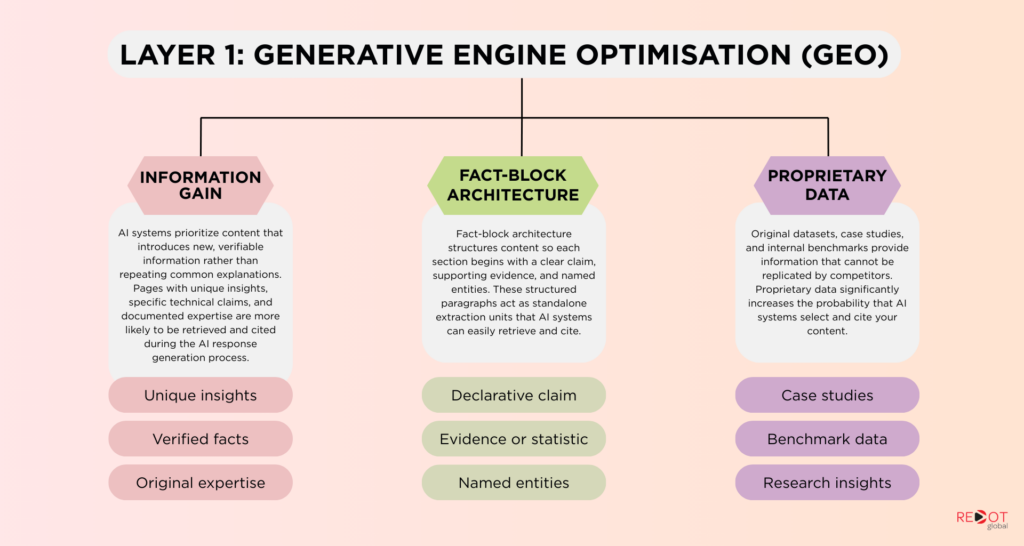
Generative Engine Optimisation is the practice of structuring content so that large language models select it during the retrieval phase of their response generation workflow. The central concept is information gain: the degree to which your content adds new, verifiable, and specific information to the body of knowledge on a topic that no other source provides in the same form.
LLMs are trained to avoid redundant data. When a retrieval system evaluates ten pieces of content on the same topic, it selects the ones that offer the highest density of unique, verifiable information. Generic explainer content that restates publicly known definitions is the least likely to be selected. First-person documented expertise, proprietary data, and specific technical claims backed by verifiable evidence are the most likely to be selected.
The Fact-Block Architecture
The most actionable GEO implementation method is what we call fact-block architecture: structuring content so that each H2 or H3 section opens with a standalone declarative paragraph of 40 to 60 words that contains the core claim, a supporting statistic or evidence point, and a named entity (a person, organisation, tool, or study). This paragraph functions as a self-contained extraction unit for LLM retrieval.
The principle is confirmed by research from Growth Memo, which found that 44.2 percent of all LLM citations come from content in the first 30 percent of an article. Getting your most specific, verifiable claims out early is not just good writing structure. It is the architectural decision that determines whether your content gets retrieved.
A fact-block paragraph for a GEO-optimised section looks like this:
GEO FACT-BLOCK EXAMPLE Weak version: Server speed is important for SEO. A slow server can hurt your rankings. GEO-optimised version: In Redot Global's infrastructure audits across multi-regional AWS environments in Singapore, Canada, and Germany, sites with TTFB above 1,800ms received 30 to 40 percent fewer crawl visits per Google Search Console session than equivalent sites below 800ms.
The second version contains named entities (Redot Global, AWS, Google Search Console), specific measurements (1,800ms, 800ms, 30 to 40 percent), and a causal chain that connects the technical claim to a business outcome. It is structurally citable. The first version is not.
Proprietary Data as a Citation Multiplier
Original data that no other source can replicate is the highest-value GEO asset a brand can produce. Case study outcomes, internal benchmark data, client result aggregations, and original survey findings are structurally immune to commoditisation because the dataset itself belongs to the publishing brand.
When Redot Global documents that we took starlightjewellery.com.sg from zero page-one visibility to 500 keywords ranking on page one, achieving a 7x increase in organic traffic and 10x revenue growth in four months, that outcome is not reproducible by any competitor’s content. It is a citable fact with named entities, specific metrics, and a verifiable timeline. AI systems select it because it adds information the broader web cannot provide from any other source.
Layer 2: Answer Engine Optimisation (AEO)
Designing Content for Conversational Query Resolution
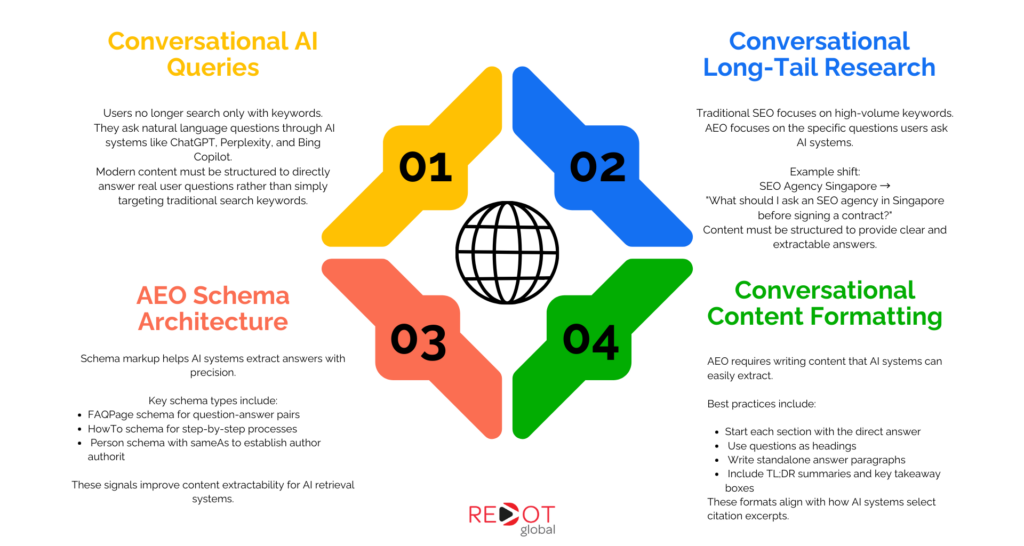
Answer Engine Optimisation addresses a specific and growing query class: conversational long-tail queries submitted through dialogue-based AI interfaces. When a business owner types “what should I look for in a Singapore SEO agency” into ChatGPT or Perplexity, they are not entering a keyword. They are asking a question in natural language and expecting a structured, specific answer.
ChatGPT alone has surpassed 900 million weekly active users as of February 2026, with users sending over 2.5 billion messages per day. Perplexity, Bing Copilot, and Apple Intelligence each represent additional conversational search channels with distinct citation preferences. Optimising for traditional keyword search while ignoring these conversational surfaces leaves the majority of 2026 search interactions unaddressed.
The Conversational Long-Tail: A Different Keyword Universe
Traditional keyword research identifies high-volume head terms and optimises for competition-weighted positions. Conversational long-tail research identifies the specific questions real users ask AI systems and structures content to answer them with maximum extractability.
The difference is substantial in practice:
|
Traditional Keyword
|
Conversational Long-Tail Equivalent
|
AEO Content Approach
|
|---|---|---|
|
SEO agency Singapore
|
What should I ask an SEO agency in Singapore before signing a contract?
|
Direct answer paragraph + FAQ schema
|
|
Core Web Vitals
|
Why is my website failing Core Web Vitals on mobile but passing on desktop?
|
Technical explanation with device-specific detail
|
|
Google Ads cost
|
Why am I paying more per click than my competitors on the same keywords?
|
Quality Score explanation with cost model
|
|
GEO optimisation
|
How do I get my brand cited in ChatGPT and Perplexity answers?
|
Step-by-step fact-block architecture guide
|
AEO Schema Architecture
The technical implementation of AEO runs through Schema.org structured data. Three schema types are most critical for conversational query resolution:
- FAQPage schema: Maps each question in your FAQ section to its direct answer. AI systems that process structured data can extract question-answer pairs directly, bypassing the need to parse surrounding prose. Every blog post and service page should carry FAQPage schema.
- HowTo schema: Structures step-by-step processes in machine-readable format. For process-oriented queries like “how do I improve my TTFB,” HowTo schema makes each step individually extractable.
- Person schema with sameAs: Links the author entity to their LinkedIn profile, Google Scholar profile, or industry publication history. AI systems that verify author authority check the sameAs chain. An author without verifiable entity connections receives lower authority weighting during retrieval.
The Google Search Central documentation on structured data confirms that structured data does not directly cause ranking improvements but improves eligibility for rich results and enhances content extractability for AI systems processing your pages.
Conversational Content Formatting
Beyond schema, AEO requires specific formatting decisions at the prose level:
- Open every H2 and H3 with the answer. Not a setup, not context, not a teaser. The direct answer. Conversational AI systems extract from the opening sentences of sections. If the answer is in paragraph three, it will not be extracted.
- Write questions as headings. H2 and H3 headings phrased as the actual user question (“What is the Inefficiency Tax in digital marketing?”) align directly with how conversational queries are phrased and signal to extraction algorithms exactly what the following section answers.
- Use standalone answer paragraphs. Each section should contain at least one paragraph that makes complete sense as a standalone excerpt. Avoid paragraphs that depend on context established earlier in the post to be understood.
- Include TL;DR sections and key takeaway boxes. Pre-compressed summaries are among the most frequently extracted content elements in AI Overviews because they present the information in a format the AI does not need to further condense.
Layer 3: SGE and AI Mode Optimisation
Winning the Google Interface Layer
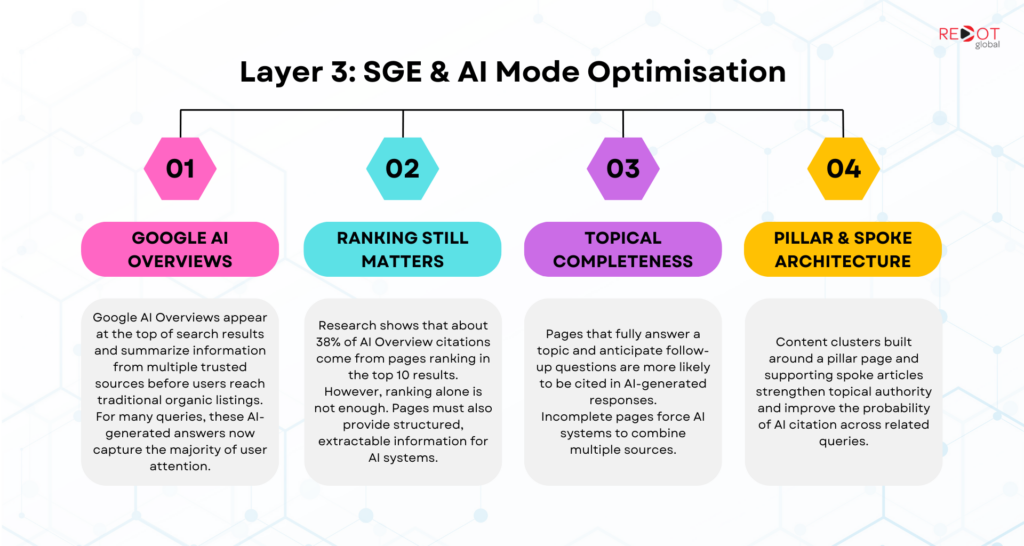
Google’s Search Generative Experience, now fully deployed as AI Mode and surfaced through AI Overviews on standard search results, represents the most commercially critical citation channel for Singapore businesses. Unlike Perplexity or ChatGPT, which operate as separate platforms, Google AI Overviews appear directly above the organic results on queries where hundreds of millions of searches per day occur.
The citation mechanics for Google AI Mode are more tightly coupled to traditional SEO signals than other AI platforms. Research by Ahrefs, updated in early 2026 across 863,000 keywords and 4 million AI Overview URLs, found that approximately 38 percent of AI Overview citations come from pages ranking in the top ten, down from 76 percent in mid-2025 as Google’s query fan-out process draws from a wider source pool. Ranking matters for AI Mode visibility in a way that it does not for ChatGPT or Perplexity citations. But ranking alone is insufficient. Pages that rank in the top ten but lack the structural requirements for AI extraction are bypassed in favour of lower-ranking pages that are better structured for citation.
Topical Completeness: The SGE Differentiator
The selection criterion that separates cited pages from non-cited pages within the top ten is topical completeness: whether a page covers the subject so thoroughly that the AI system does not need to consult a second source to construct a complete answer.
A page that answers one aspect of a query well but leaves adjacent questions unaddressed forces the AI to source from multiple documents. Pages that answer the primary query and anticipate the follow-up questions a user would naturally ask are more likely to be the sole or primary citation for that query.
This is why the pillar and cluster content model, which we have implemented across the Redot Global content architecture, is structurally aligned with SGE optimisation requirements. A cluster article that covers one specific dimension of a topic in exhaustive depth is more likely to be cited as the definitive source on that specific dimension than a broader article that covers it partially.
The Pillar and Cluster Model as a Citation Architecture
The relationship between this post, the Inefficiency Tax analysis, the information gain content strategy guide, and the Beyond the Keyword pillar guide is not coincidental. It is the deliberate design of a topic cluster built to satisfy both traditional ranking signals and AI citation requirements simultaneously.
Here is how the architecture functions for AI citation :
|
Content Layer
|
URL
|
SGE Citation Role
|
|---|---|---|
|
Pillar
|
Cited for broad definitional and strategic queries about SEO in 2026
|
|
|
Cluster: Infrastructure
|
Cited for technical queries about TTFB, Core Web Vitals, crawl budget
|
|
|
Cluster: Citation Economy (this post)
|
/geo-aeo-sge-citation-economy/
|
Cited for queries about GEO, AEO, AI citations, and AI search visibility
|
|
Cluster: Content Strategy
|
Cited for queries about information gain, fact-block architecture, BLUF, and entity density
|
|
|
Cluster: E-E-A-T and Trust Architecture
|
Cited for queries about author entity building, Person schema, YMYL compliance, and E-E-A-T verification
|
Each cluster article links back to the pillar with descriptive anchor text. The pillar links forward to each cluster at the relevant section. This bidirectional internal link architecture signals to Google’s systems that the content cluster represents topical authority rather than isolated posts. According to Moz’s internal linking research, internal link equity is a material ranking factor at the individual page level. The cluster model concentrates authority on every page simultaneously through interconnection.
Entity Completeness in AI Overviews
Google AI Mode is built on Google’s Knowledge Graph, the entity database that maps relationships between people, organisations, topics, and concepts. Content that references entities Google has high confidence in, with correct relationships between them, is preferred for AI Overview inclusion over content that uses generic language.
For Redot Global, this means every piece of content should explicitly reference the named entities that establish authority in the relevant topic domain: AWS Network Partner status, Google Partner certification, specific client case studies with named outcomes, and the named technical standards (Google Search Central documentation, Core Web Vitals thresholds from web.dev, Schema.org specifications) that AI systems use to verify technical claims.
Entity Authority and the Knowledge Graph
How AI Systems Verify Whose Content to Trust
Google’s E-E-A-T framework, introduced in the Beyond the Keyword pillar guide, has evolved from a quality guideline into a verification architecture. In the context of AI citation selection, E-E-A-T functions as the trust layer that AI systems check before elevating a source to cited status.
The critical shift from traditional E-E-A-T to AI-era E-E-A-T is that AI systems do not evaluate trust signals in isolation. They verify authority through entity relationships: whether the author entity is linked to a known organisation entity, whether that organisation is referenced by authoritative third-party entities, and whether the content aligns with the established positions of trusted entities in the same topic domain.
Building Author Entity Authority
An author without a verified entity presence is a liability in AI citation selection. A verified author entity requires:
- A consistent authorship record: Multiple pieces of published content under the same name, across multiple authoritative domains where possible, creates a verifiable publication pattern that AI systems can identify.
- Person schema with sameAs links: JSON-LD Person markup on every author bio page linking to LinkedIn, Google Scholar, industry publication profiles, and other verifiable identity anchors. This is the technical mechanism that connects the author’s name on your site to the broader entity graph.
- Third-party entity mentions: Press coverage, conference speaking records, academic or industry publications, and professional directory listings that reference the author entity by name and connect them to a verifiable area of expertise.
- Credentials that match the topic domain: An article about AWS infrastructure carrying authorship from an AWS-certified engineer receives stronger authority signals than the same article published anonymously. The credential-topic alignment is part of what AI systems evaluate when verifying expertise claims.
Digital PR as a Citation Multiplier
Why Off-Site Presence Directly Affects On-Site AI Citations
Analysis of 250,000 citations across 40,000 AI responses found that third-party earned sources remain the most frequently cited source type across ChatGPT, Gemini, and Perplexity, consistently outweighing citations from a brand’s own domain. This is not a coincidence. It reflects a deliberate design principle: AI systems calibrate trust against consensus. If multiple independent, authoritative sources reference your brand positively and specifically, the AI interprets this as evidence of genuine authority rather than self-claimed expertise.
For Singapore businesses, the practical implication is that digital PR activity, which many businesses treat as separate from and secondary to SEO, is now a direct input into AI citation frequency. Every press mention in an authoritative regional publication, every feature in an industry directory, and every independent review that references your brand by name and area of expertise contributes to your entity authority score in the AI knowledge graph.
The Platforms That Matter Most for AI Citation
AI systems do not weight all third-party sources equally. The sources most frequently reflected in AI citation patterns include:
- Major news and media publications: Coverage in publications that AI training datasets include at high weight. For Singapore businesses, the Business Times, The Straits Times, and regional tech publications like e27 and Tech in Asia carry significant weight in regional AI citation patterns.
- Reddit and community platforms: Reddit appears disproportionately in AI Overview citations and in LLM training data relative to its traditional SEO authority. A thread on r/singapore or r/SEO that mentions your brand in a specific, positive context contributes to entity recognition in ways that traditional link building does not.
- Industry certifications and partner directories: Google Partner directories, AWS Partner Network listings, and accreditation body references create verifiable entity connections between your brand and established institutions. These are citation signals that AI systems can verify directly.
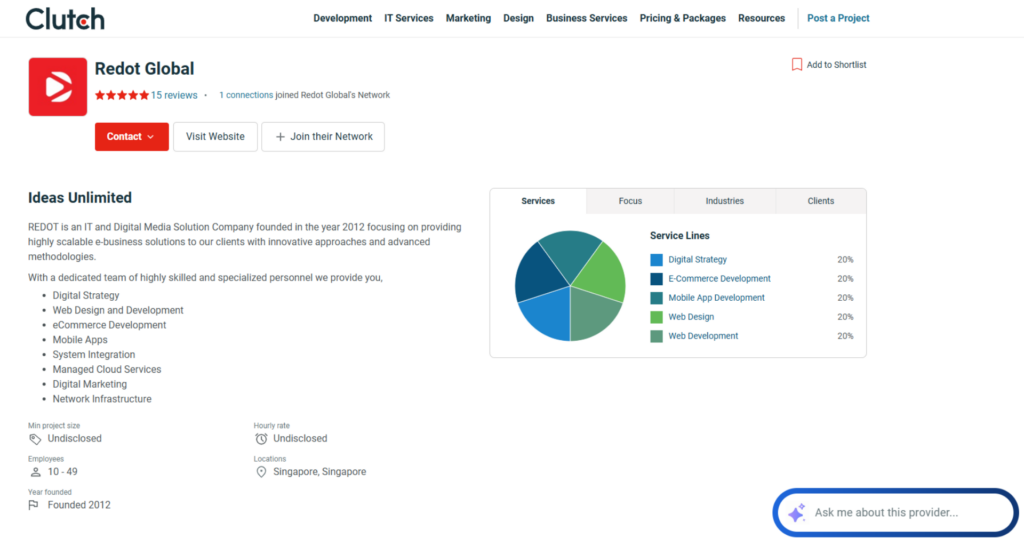
- G2, Clutch, and structured review platforms: Review platforms with structured data are increasingly reflected in AI citation patterns for commercial queries. A well-maintained Clutch profile with specific service reviews contributes to the entity verification chain for queries like “best SEO agency Singapore.”
The Technical Access Layer: Why Infrastructure Determines Citation Eligibility
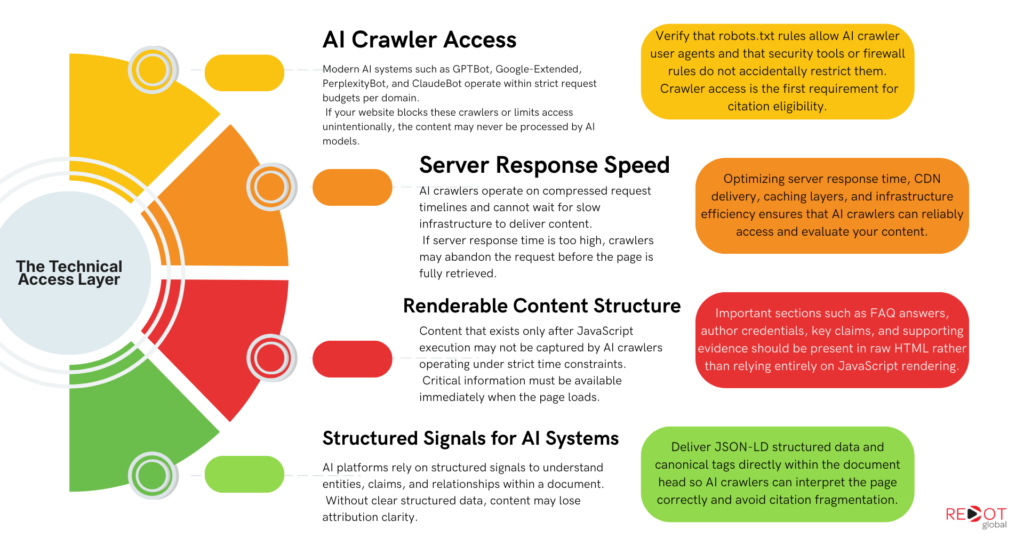
Everything covered in this post, the fact-block architecture, the conversational formatting, the schema markup, the entity authority building, becomes irrelevant if AI crawlers cannot access, render, and parse your content. This is the technical foundation that underpins the entire Citation Economy framework, and it is the dimension that most content-focused GEO advice ignores entirely.
As we documented in our analysis of The Inefficiency Tax, the same infrastructure failures that reduce Google’s crawl efficiency also exclude content from AI crawler access. GPTBot, Google-Extended, PerplexityBot, and ClaudeBot all operate within finite request budgets per domain. Slow server response, JavaScript rendering gaps, and excessive redirect chains cost AI crawlers the same way they cost Googlebot.
The AI Crawler Accessibility Checklist
For content to be citation-eligible across all major AI platforms, the following technical conditions must be satisfied:
- Server response speed: AI crawlers operate on compressed request timelines. Slow server response risks crawler abandonment before content is received.
- Server-side rendering for critical content: Content that exists only after JavaScript execution is not guaranteed to be captured by AI crawlers operating on compressed timelines. FAQ sections, author bios, and structural claim paragraphs must exist in raw HTML.
- Crawl access for AI bot user agents: Verify that robots.txt does not inadvertently block GPTBot, Google-Extended, PerplexityBot, or ClaudeBot. Each has a distinct user agent string that must be explicitly permitted if your robots.txt uses a whitelist approach.
- Structured data in JSON-LD in the document head: Schema markup delivered via JavaScript injection may not be processed by AI crawlers in the same way it is processed by Googlebot’s secondary rendering wave.
Canonical tags in raw HTML: AI systems use canonical signals to avoid processing duplicate content. Canonicals delivered via JavaScript may not be honoured by all AI crawlers, leading to citation fragmentation across canonical and non-canonical URL variants.
REDOT ENGINEERING VERDICT You cannot engineer citation visibility on infrastructure that excludes the crawlers doing the citing. The Citation Economy framework operates on a two-layer foundation: the technical access layer (infrastructure, rendering, crawlability) and the content value layer (GEO, AEO, SGE). Failures in the access layer are invisible from the content layer, which is why businesses optimising their content while ignoring their server configuration are solving the wrong problem first.
How Redot Global Measures and Builds AI Citation Visibility
Measuring AI citation visibility requires a different methodology from traditional rank tracking. A brand can hold position one for a competitive keyword while receiving zero AI citations, and a brand with moderate organic rankings can be cited in AI Overviews for dozens of queries each month. The metrics are not correlated.
The Citation Visibility Audit
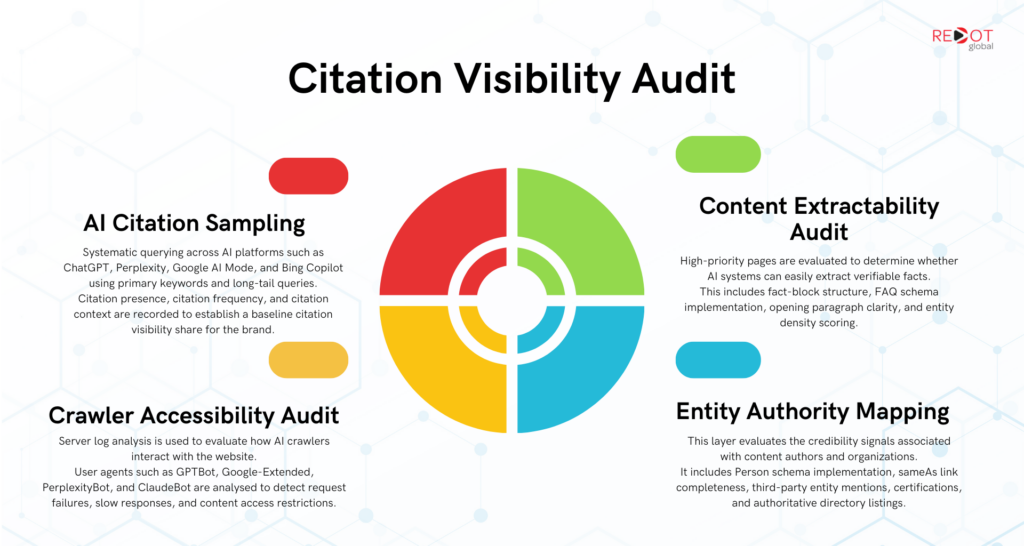
A Citation Visibility Audit covers four diagnostic layers:
- AI citation sampling across platforms: Systematic querying of ChatGPT, Perplexity, Google AI Mode, and Bing Copilot using the target brand’s primary keywords and long-tail query variants. Citation presence, citation frequency, and citation context are recorded to establish a baseline visibility share.
- Crawler accessibility audit: Server log analysis for AI bot user agents (GPTBot, Google-Extended, PerplexityBot, ClaudeBot) to identify request failure rates, response time distributions, and content access gaps. Many businesses discover for the first time that significant crawler populations have been returning server errors or timeout responses for months.
- Content extractability audit: Evaluation of each high-priority page against fact-block architecture requirements, FAQ schema implementation, opening paragraph extractability, and entity density scoring. Pages are prioritised for rewriting based on citation gap size and commercial query alignment.
- Entity authority mapping: Review of Person schema implementation for all content authors, sameAs chain completeness, third-party entity mention inventory, and certification or partner directory listing status across Google, AWS, and industry-specific directories.

The Implementation Sequence
For businesses entering the Citation Economy without existing GEO infrastructure, the implementation sequence matters. The access layer must be validated before content engineering investment, because content investment on a technically broken platform is wasted.
|
Phase
|
Action
|
Timeline
|
Primary Outcome
|
|---|---|---|---|
|
01
|
Technical access audit and AI crawler unblocking
|
Week 1-2
|
Confirm all AI bots can access, render and parse priority pages
|
|
02
|
Schema implementation: FAQPage, Person, Organisation, Article
|
Week 2-3
|
Structured data coverage on all priority pages and author profiles
|
|
03
|
Content rewrite: fact-block architecture for top 10 priority pages
|
Week 3-6
|
High-density extractable content on highest-citation-potential pages
|
|
04
|
Entity authority building: Digital PR, directory listings, review platforms
|
Month 2-4
|
Third-party entity verification chain established
|
|
05
|
Citation monitoring and iteration
|
Ongoing
|
Baseline citation share measured and incrementally expanded
|
Conclusion: Engineering Your Share of the Citation Economy
The Citation Economy is not a trend that is coming. It is the current reality for every business whose customers use AI-assisted search to make decisions. The businesses that understand this as an engineering problem rather than a content problem are building a sustainable competitive advantage. The businesses treating it as a content volume problem are running faster on a treadmill that is slowing down.
GEO, AEO and SGE are not three separate strategies. They are three layers of the same framework: making your content technically accessible to AI crawlers, structurally extractable by AI retrieval systems, and authoritative enough by AI trust verification standards to be selected over competitive sources. None of the three layers works in isolation.
The full picture of modern SEO, from technical infrastructure through information gain through citation architecture through trust signals, is covered in our master guide to Search Engine Optimization in 2026. The Citation Economy is the third dimension of that framework. The infrastructure foundation it depends on is covered in the Inefficiency Tax analysis. The content strategy that feeds it is covered in our information gain content strategy guide.The trust architecture that determines citation eligibility is covered in our E-E-A-T authority guide. Together, the five posts constitute a complete technical brief for building a citation-visible digital presence in 2026.
Ready to build your Citation Economy presence?
Contact Redot Global for a GEO Readiness Audit. We will assess your current AI citation visibility, identify the access and content gaps costing you citations today, and build the implementation roadmap to establish your brand as a trusted source across ChatGPT, Perplexity, Gemini, and Google AI Mode.
Frequently Asked Questions
What is Generative Engine Optimisation (GEO)?
Generative Engine Optimisation is the practice of engineering content to be selected by AI retrieval systems during the retrieval phase of a RAG (Retrieval-Augmented Generation) workflow. Where traditional SEO optimises for search engine ranking, GEO optimises for AI citation selection. The core requirement is information gain: content that adds verifiable, specific, and uniquely sourced information to a topic is structurally preferred over content that restates commonly available knowledge.
How is AEO different from traditional SEO?
Traditional SEO targets keyword-based queries submitted through a search interface and optimises for position in a ranked list of results. Answer Engine Optimisation targets conversational long-tail queries submitted through dialogue-based AI interfaces such as ChatGPT, Perplexity, and Bing Copilot, and optimises for being the direct answer that the AI system returns rather than a link in a list. The content formatting requirements, schema implementation, and query research methodology are all different.
What is SGE and is it the same as AI Mode?
Google’s Search Generative Experience (SGE) was the beta label for Google’s AI-generated answer panels, which began appearing in Google Search from 2023. In 2025, Google retired the SGE label and the functionality became the permanent AI Overviews feature and, for eligible users, AI Mode. AI Mode is the fully dialogue-based search experience. AI Overviews are the AI-generated summary panels that appear at the top of standard search results. For optimisation purposes, the content and technical requirements are consistent across both surfaces.
Why do AI crawlers need different treatment from Googlebot?
Googlebot operates within Google’s broader crawl infrastructure with well-documented behaviour, a secondary JavaScript rendering wave, and integration with Google Search Console diagnostics. AI crawlers from OpenAI (GPTBot), Perplexity, and Anthropic operate with different request budgets, different JavaScript rendering capabilities, and different robots.txt interpretation conventions. Verifying that your robots.txt permits each AI bot user agent, and that your server response times are consistently below 200ms, is a separate technical check from standard Googlebot optimisation.
How do I know if my brand is currently being cited in AI responses?
Manual citation sampling is the most direct method: systematically query ChatGPT, Perplexity, Google AI Mode, and Bing Copilot using your target keywords and long-tail query variants and record citation presence and context. Dedicated AI citation tracking tools are beginning to emerge, but as of 2026, manual sampling combined with server log analysis for AI bot user agent traffic remains the most reliable methodology for establishing a citation visibility baseline.
Can a brand with moderate domain authority compete for AI citations against larger brands?
Yes, and in some cases more effectively. AI citation selection prioritises content quality, topical completeness, and information density over domain authority in a way that traditional ranking does not. A smaller brand with a well-documented original case study, properly implemented schema markup, and a fact-block content architecture can be cited alongside or instead of larger competitors for specific queries where their content is the most specific and extractable answer available. The Citation Economy rewards content engineering over budget scale.
What is the relationship between internal linking and AI citation visibility?
Internal linking contributes to AI citation visibility through two mechanisms. First, it signals topical authority to Google’s systems by demonstrating that multiple pieces of content on your domain address a subject comprehensively and are interconnected through deliberate architecture rather than random publication. Second, it concentrates PageRank on the pages most relevant to each topic cluster, improving their organic ranking positions and therefore their eligibility for AI Overview citation given that approximately 76 percent of AI Overview citations still come from top ten organic results. The hub and spoke model, where spoke articles link back to a pillar with descriptive anchor text and the pillar links forward to each spoke, is the optimal implementation of this principle. For a full treatment of how internal link architecture affects SEO performance, see our Inefficiency Tax analysis.

Co-Founder and Director, Redot Global
Suneth Silva is the Co-Founder and Director of Redot Global, a Singapore-based technology company specialising in AI-driven digital marketing, enterprise software development, and business automation. He leads strategy across technical SEO, performance marketing, and marketing analytics while overseeing engineering teams building cloud-native platforms and AI-enabled systems. His work integrates machine learning, LLM development, semantic search, and predictive analytics to deliver measurable growth for clients across hospitality, automotive, retail, finance, and government. With a background spanning software engineering, systems architecture, and applied AI, Suneth focuses on building end-to-end digital ecosystems that unify technology, data, and strategy.